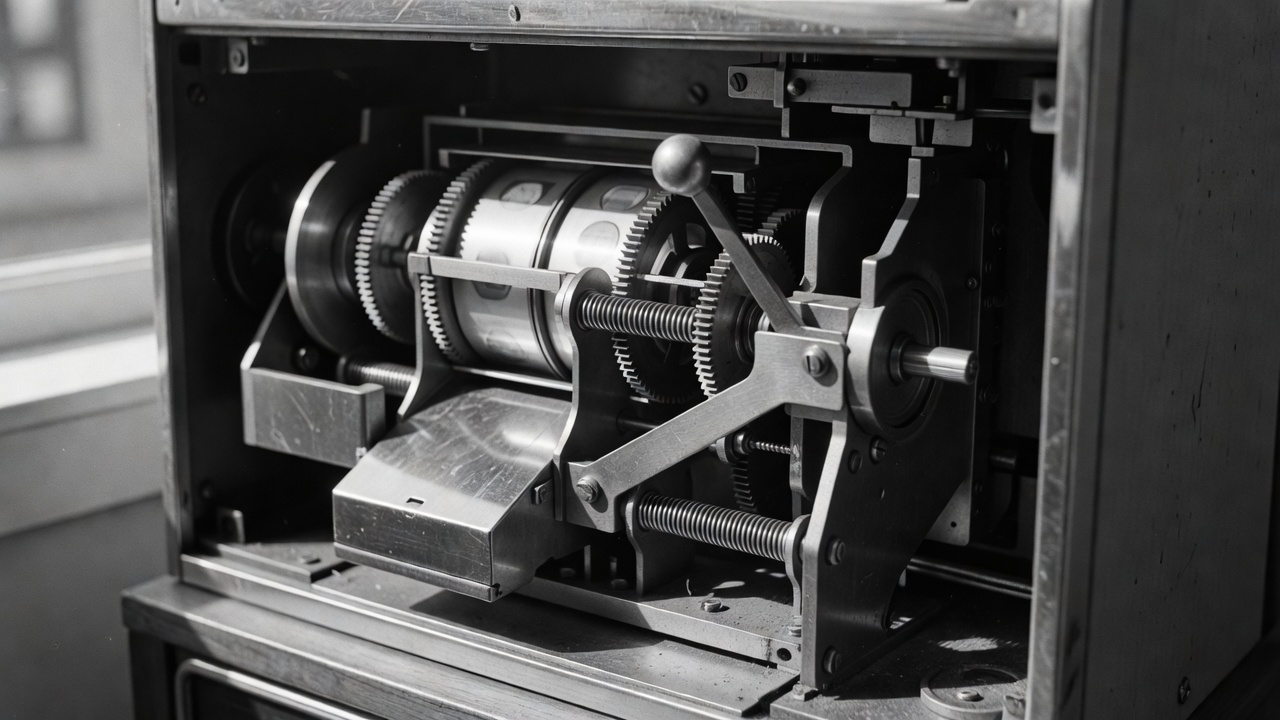
Charles Fey built his first slot machine in San Francisco in 1895 in a small machine shop. He was not an intellectual. He was a mechanic solving a practical problem: how to automate the payout of a gambling machine so that a single operator could manage multiple games without manually handling cash.
The Liberty Bell, as he called it, was elegant in its simplicity. Three reels. Each reel had ten symbols. The player pulled a lever, the reels spun, and if all three matched, a payout mechanism dispensed coins automatically. No human judgment. No dealer discretion. Pure mechanism.
The Design for Reward Uncertainty
What Fey understood, whether consciously or intuitively, was the power of variable-ratio reinforcement. The player did not win on every pull. They won on unpredictable pulls. Research by B.F. Skinner decades later would formalize this as the most potent form of behavioral reinforcement: unpredictable reward creates more persistent behavior than predictable reward.
In laboratory settings, pigeons given food on a fixed schedule (every fifth peck) will stop pecking quickly once the food stops. Pigeons given food on a random schedule (averaging every fifth peck but unpredictable) will peck obsessively for hours even after all reward has ceased. The uncertainty is the engine of persistence.
Fey's machine embodied this principle mechanically. The lever pull was the action. The spin was the delay that created anticipation. The three matching symbols were the variable reward. Every element was designed to trigger the neural pathways associated with reward-seeking.
The Mechanical Payout Advantage
Before the Liberty Bell, slot machines were operated by attendants. A player would pay money, pull a lever, and an attendant would manually assess the outcome and pay or deny. This human mediation was inefficient and created opportunity for cheating (both by players and operators).
Fey's automatic payout solved this. The machine itself determined the outcome and dispensed the reward. No human judgment. No negotiation. The player either won or did not. This clarity was psychologically important. Predictable mechanics feel fairer than human discretion, even if the odds are identical.
Mechanically, the automatic payout also meant that the machine could operate continuously. Earlier machines required operator intervention. Fey's Liberty Bell could run all day, paying out winners, and the operator collected the losers' money. This was the first true vending machine for gambling.
The Illusion of Control
The lever was not mechanically necessary. By 1895, Fey could have designed a machine that spun on a timer. But the lever mattered psychologically. It gave the player a sense of agency. They pulled. They initiated the outcome. This produced the illusion of control.
In experimental psychology, the illusion of control (Langer, 1975) describes how people believe they influence inherently random outcomes when they take an action. A player pulling a lever on a slot machine feels like they are making a choice, even though the outcome is predetermined the moment the lever is pulled (mechanically).
This illusion increases engagement and persistence. A purely automatic machine (where the player watches a spinning wheel) creates less investment than a machine where the player physically acts. The lever was psychology, not mechanics.
The Three-Reel Layout and Symbol Choice
Fey settled on three reels and ten symbols per reel. This produced 1,000 possible combinations. Of those, only a few paid out. The Liberty Bell symbol was the rarest and paid the most, producing the biggest coins drop into the tray.
Why three reels? Mechanically, three was the minimum needed to create seeming complexity while remaining buildable. Psychologically, three created optimal cognitive load. Two reels would feel trivial. Four would be overwhelming. Three felt like the amount of information a player could process during the anticipatory moment.
The symbols themselves (bells, horseshoes, diamonds) were arbitrary but important. Fey chose symbols that could be embossed or engraved into physical wheels with acceptable precision. The Liberty Bell was the flagship symbol because it was patriotic (San Francisco after the gold rush was intensely patriotic) and because bells can be reliably machine-cut.
The Addiction Architecture
From a modern clinical perspective, Fey's Liberty Bell exhibits nearly every design feature associated with problem gambling:
Variable-ratio reinforcement (Skinner's finding): unpredictable rewards create compulsive behavior. Illusion of control: the lever pull creates a false sense of agency. Near-miss experiences: aligning two symbols out of three nearly always occurs within a session, producing the feeling that a win is imminent (Sharpe and Tarrier, 1992). Rapid cycle time: a spin can complete in seconds, enabling hundreds of plays per hour. Multiplier psychology: when three symbols align, multiple coins drop, creating an experience of abundance that exceeds the mathematical payout.
Fey did not invent these features to addict players. He invented them to maximize engagement and retention. But the net effect was a machine finely tuned to compulsive play.
Modern Echoes
Every electronic slot machine today operates on the same behavioral principles Fey discovered mechanically. The lever became a button (less agency, actually, despite the appearance of choice). The physical reels became graphics (less mechanical resistance, more speed). The coins became digital credits. But the core loop remains unchanged: action, delay, variable reward, repeat.
The house advantage in Fey's Liberty Bell was roughly 20 percent (most machines kept 1 coin in 5). Modern slots have RTPs that vary by jurisdiction but typically range from 85 to 98 percent. So players have slightly better odds today, but they also play thousands of times faster.
Understanding Fey's invention requires accepting that he accidentally (or intuitively) designed a behavioral modification device. The machine did not prey on addiction; it exploited the normal human response to unpredictable reward. This is the uncomfortable truth of modern gambling: we have not made machines more fair. We have only made them faster.