The modern era of gaming has witnessed a considerable shift in the locus of play. Where once the customer travelled to the establishment, the establishment has now, in effect, travelled to the customer's pocket. This arrangement carries with it a particular technical vexation that the landbound casino never faced: the finite battery capacity of the mobile device.
This is not, one hastens to add, a problem exclusive to gambling. Video streaming, social media engagement, and continuous email checking produce similar effects. However, the gambler encounters the issue with particular acuity. The nature of casino gaming, with its persistent animations, real-time dealer feeds, and constant illumination of the display, creates conditions markedly more demanding than ordinary application use.
The Physics of Depletion
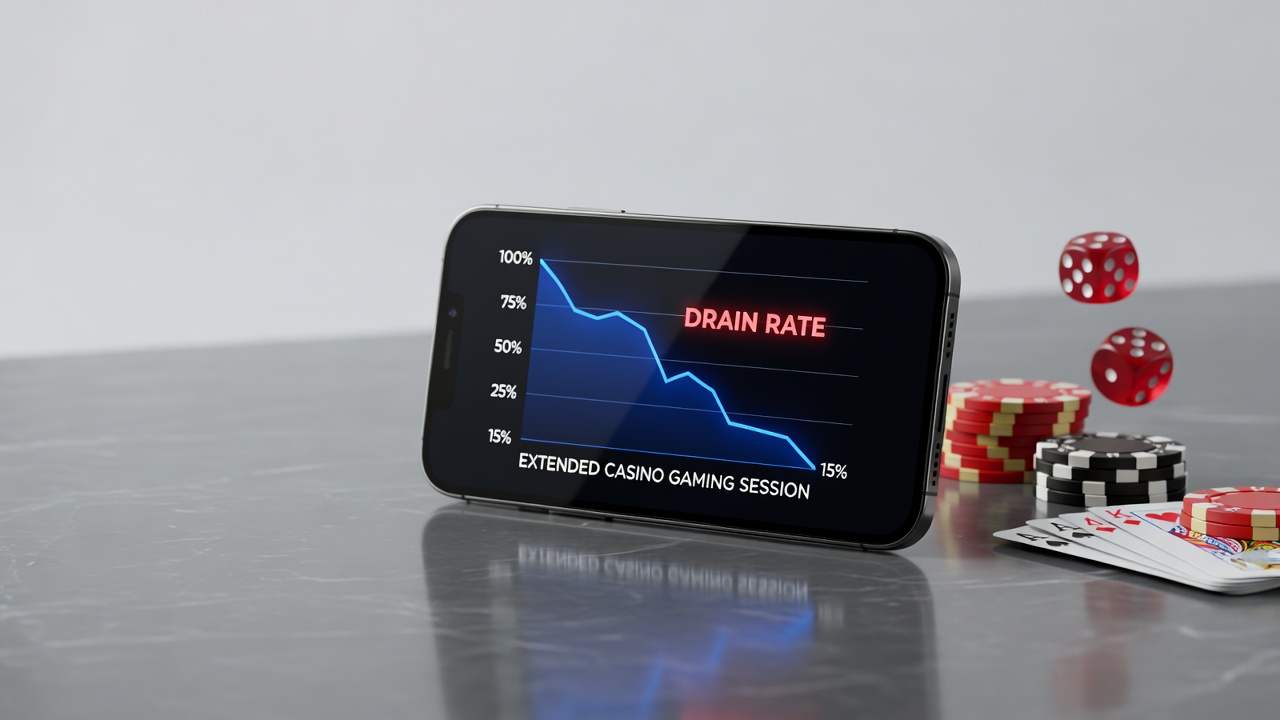
Consider the technical reality. A smartphone's display consumes somewhere between 30 and 50 percent of the device's total power budget, depending upon screen brightness and resolution. This is simply the cost of having a machine that displays images continuously. Gaming applications, particularly those with live-action elements, push the display to work at maximum capacity for extended periods. The pixels do not dim. The refresh rate does not decrease. The brightness, particularly in dimly lit rooms or late evening hours, remains elevated to ensure visibility of the action.
Beyond the display itself, the graphics processing unit works in tandem with the central processor to maintain smooth animation and rapid response times. This constant computational labour is not inconsiderable. A device playing back video or processing graphics consumes roughly four times the power of one in idle state.
Add to this the location services, which many operators employ to verify that the user remains within licensed jurisdictions, and you have a system drawing substantial power from multiple components simultaneously. A full battery charge, in these circumstances, may sustain play for only three or four hours.
Practical Mitigation Strategies
One is not entirely without recourse. The following approaches have merit in practice:
- Reduce screen brightness deliberately. Most devices allow setting to 40 percent without materially impairing visibility.
- Disable location services when not actively required for verification purposes.
- Close other applications entirely. Background processes are tax on the battery.
- Enable low-power mode if the device offers it, though this may reduce graphical fidelity.
- Keep the device in a cool environment; heat accelerates battery degradation and consumption.
- Use external power banks designed specifically for mobile devices, maintaining charge during extended sessions.
The last point warrants emphasis. A small portable battery of 10,000 to 20,000 milliamp-hours can extend a session considerably without requiring return to the nearest power socket.
The Regulatory Context
Some jurisdictions have begun asking questions about this matter, though not, admittedly, with any particular urgency. The United Kingdom Gambling Commission has not yet issued guidance specific to battery management, though its broader consumer protection framework suggests awareness of the issue. The Malta Gaming Authority similarly remains focused on larger questions of responsible gambling.
Yet the battery question is not merely technical. It sits at the intersection of consumer experience and responsible gaming. A player whose device fails mid-session may find themselves frustrated, potentially leading to hasty decisions upon returning to play. It is not an unfamiliar pattern: the interrupted engagement creates pressure to recover quickly, to win back what was lost, a pathway that rarely ends well.
Modern smartphones are increasingly capable machines. They are not, however, devices designed for eight hours of continuous gaming. Managing expectations around battery life is, therefore, a pragmatic contribution to more sustainable play.