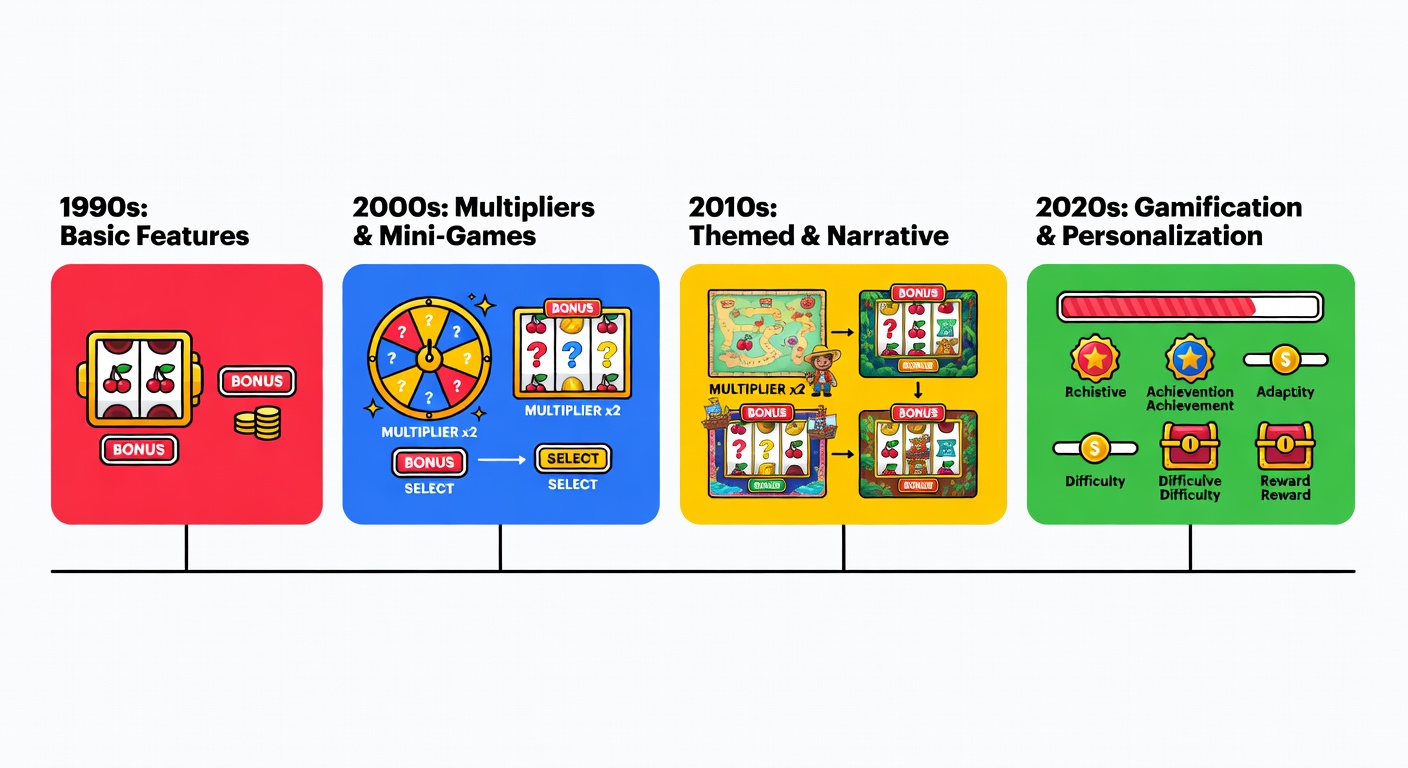
2014: The Multiplier Era
In 2014, a bonus round meant you hit a triggering symbol, the machine locked the reels, and multipliers applied to your spins. NetEnt's Gonzo's Quest (released 2010, but dominant through 2014) exemplified this: hit the free-spins feature, watch the multiplier counter increase with each cascade win. The design goal was clarity. You understood immediately what was happening.
Pragmatic Play was releasing 40-50 games per year by 2014. The bonus mechanics were standardized: free spins plus a multiplier, maybe a symbol overlay that triggered additional spins. The variance came from the RTP, not the feature design.
2016-2017: The Gamification Turn
Between 2016 and 2017, something shifted. Designers began adding decision trees to bonus rounds. You could "double" your win by guessing a card color. The feature went from automated to interactive.
Microgaming's Immortal Romance, originally released in 2009 but updated in 2016, added this layer: you could gamble bonus wins. The average player lost 10-15% of potential winnings trying to double their luck.
NetEnt and Pragmatic Play both copied the mechanic. It increased hold time per session. It also increased the mathematical complexity of the RTP calculation: now you had to model player behavior within the bonus, not just the payout schedule.
2018-2019: The Nested Feature Explosion
By 2018, bonus features were triggering bonus features. You'd hit free spins. Within the free spins, you could hit a second trigger that expanded the multiplier. Within that, a third layer would add locked reels.
Evolution Gaming, primarily a live-casino supplier, had not yet entered the slot market. But their design philosophy influenced the direction: layers of interaction. Every action revealed more possibility.
Pragmatic Play released 90+ titles in 2018. Nearly half of them included nested bonus mechanics. The goal was engagement: keep the player's attention across multiple decision points per session.
This created a new problem: RNG transparency. If your bonus had 6 nested layers, auditing the true randomness at each layer became exponentially harder. The MGA and UKGC both required detailed RNG testing for games with nested mechanics.
2020-2021: Buy-Bonus Buttons
The pandemic pushed players toward digital. Online casinos expanded. In response, game designers added "buy bonus" mechanics: for a fee (typically 50-100x your bet), you could skip straight to the feature.
Stake adopted this mechanic heavily. Their operators, Pragmatic Play primarily, built buy-bonus into 60% of new releases by 2021. The math was simple: players would pay 2x the normal cost for the feature if they could access it immediately.
Regulators started paying attention. The UKGC issued guidance in 2021 warning operators about buy-bonus mechanics: the feature had to remain achievable through regular play, not just purchasable. The RTP had to account for players who bought in.
2022-2024: The Algorithmic Complexity
Over the last two years, bonus features have become algorithmic puzzles. You're not just hitting symbols. You're making choices that affect the outcome. Some games now include a "skill element" (which is allowed under certain regulatory frameworks, though it confuses the RTP calculation).
NetEnt released Starburst XXL in 2023. The bonus round included a branching decision tree: at three points during free spins, you could choose to lock a reel or increase the multiplier. The choice changed the final payout by up to 300%.
Pragmatic Play responded with similar complexity. Their hit rate on bonus features dropped from 15% (2018 standard) to 8% (2024 standard). The payouts when you hit are higher. The feature feels like it matters more.
What This Means
Bonus evolution reflects two pressures: regulatory requirements and player boredom. In 2014, a multiplier bonus was novel. By 2024, it's invisible. Players expect decision-making, nested mechanics, and algorithmic complexity.
The RNG hasn't changed. The probability has remained auditable. But the player experience has become exponentially more complex, which means the perceived skill component has grown even as the actual randomness remains constant.
This is intentional design. It's not predatory. It's response to market demand. A bonus that your grandmother understands is no longer competitive.