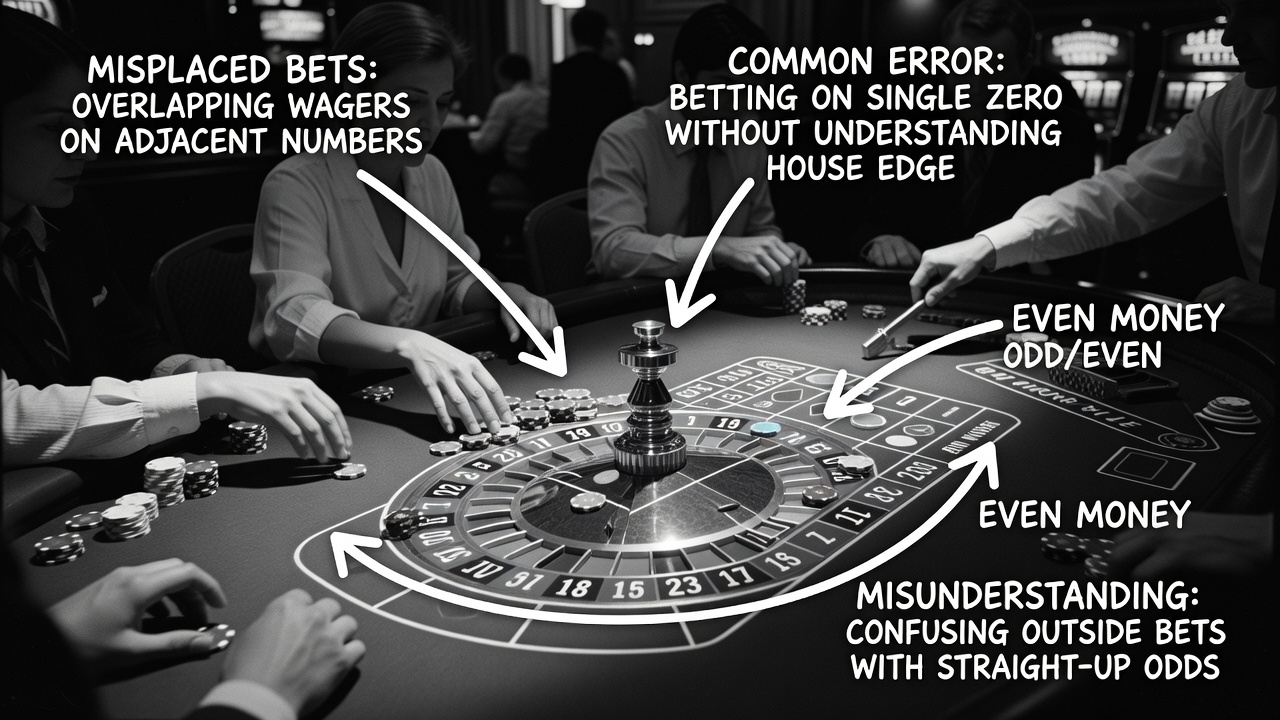
New roulette players make predictable errors. These errors are not moral failings. They are the result of misunderstanding game mechanics and probability. Accordingly, this examination addresses the most common misconceptions and their origins.
Mistake One: The Gambler's Fallacy Applied to Recent Spins
A player observes that red has come up four times consecutively. The player concludes that black is now more likely to appear on the next spin. This reasoning is incorrect. Each spin is an independent event. The probability of black on spin five is identical to the probability of black on spin one.
Why this persists: the human brain is optimized to detect patterns. A sequence of four reds appears non-random to the player even though sequences of four identical outcomes occur regularly within long play sessions. Roulette wheels in regulated casinos meet strict testing standards from authorities such as the Malta Gaming Authority and the UKGC. Random number generation on digital wheels is audited annually. The wheel does not remember previous outcomes.
Mistake Two: Betting Strategy Beats Mathematics
A player adopts the Martingale system. The system instructs the player to double the wager after each loss, thereby guaranteeing recovery of losses plus one unit of profit once a win occurs. On the surface, this appears sound. In practice, the system fails because the player either runs out of bankroll or reaches the table maximum before achieving the predicted win.
Regulatory bodies including Curacao eGaming and the UK Gambling Commission have reviewed these systems extensively. They acknowledge that no betting strategy alters the house edge. The house edge on European roulette (single-zero) is 2.7 percent. On American roulette (double-zero), the house edge is 5.26 percent. These percentages are structural. They are not overcome by changing bet sizes or sequences.
Mistake Three: Hot Numbers Are Exploitable
A player tracks spins over 100 rounds. The player observes that 17 has appeared 8 times, compared to an expected frequency of 2.7 times. The player reasons that 17 is "hot" and therefore should be wagered on preferentially. This is incorrect. The deviation from expectation indicates nothing. Over 1,000 spins, frequencies converge to the theoretical distribution.
The observation of clustering is real. Clustering is mathematically inevitable within finite sample sizes. Clustering is not predictive. A number that has appeared frequently in the last 100 spins has no elevated probability on the next 100 spins.
Mistake Four: Live Dealers Introduce Predictability
A player believes that watching a live dealer allows prediction of outcomes. Specifically, the player believes that dealer signatures in how the wheel is spun might correlate with landing zones. This belief confuses roulette with physical prediction models. Live dealer games in regulated venues are audited for randomness. Stake, DraftKings, and BetVictor employ dealers at regulated facilities. The wheels are inspected regularly. Dealer hand position is randomized within operator guidelines precisely to prevent even theoretical prediction.
A single outcome from a dealer spin does not contain information about subsequent outcomes. Regulatory standards require this independence.
Mistake Five: Believing Your System is Different
A player develops a personal system combining hot number tracking, martingale betting, and position observation at the table. The player believes this synthesis is novel. The player is confident that the combination overcomes the house edge. Accordingly, the player risks significant capital on this system. This is the most costly mistake.
Every system ever proposed has been examined by statisticians, casino operators, and regulatory authorities. No system has altered the mathematical house edge. The edge exists because payout ratios are lower than true odds. Roulette pays 35-to-1 on single numbers. True odds are 36-to-1. That difference compounds across the lifetime of play.
What Works Instead
Two approaches function within the constraints of the game. First, accept the house edge as a cost of entertainment. Treat roulette as an experience purchase, comparable to attending cinema. Allocate a fixed entertainment budget. Play that budget. Stop. This approach limits expected loss to the allocated amount.
Second, understand variance. Short-term outcomes deviate from expected value. A player can be ahead or behind over any given 20-spin session despite the house edge. Volatility exists. This is observable fact. However, volatility converges to the house edge across larger sample sizes. A player who intends to play 1,000 spins should not believe variance will overcome structure.