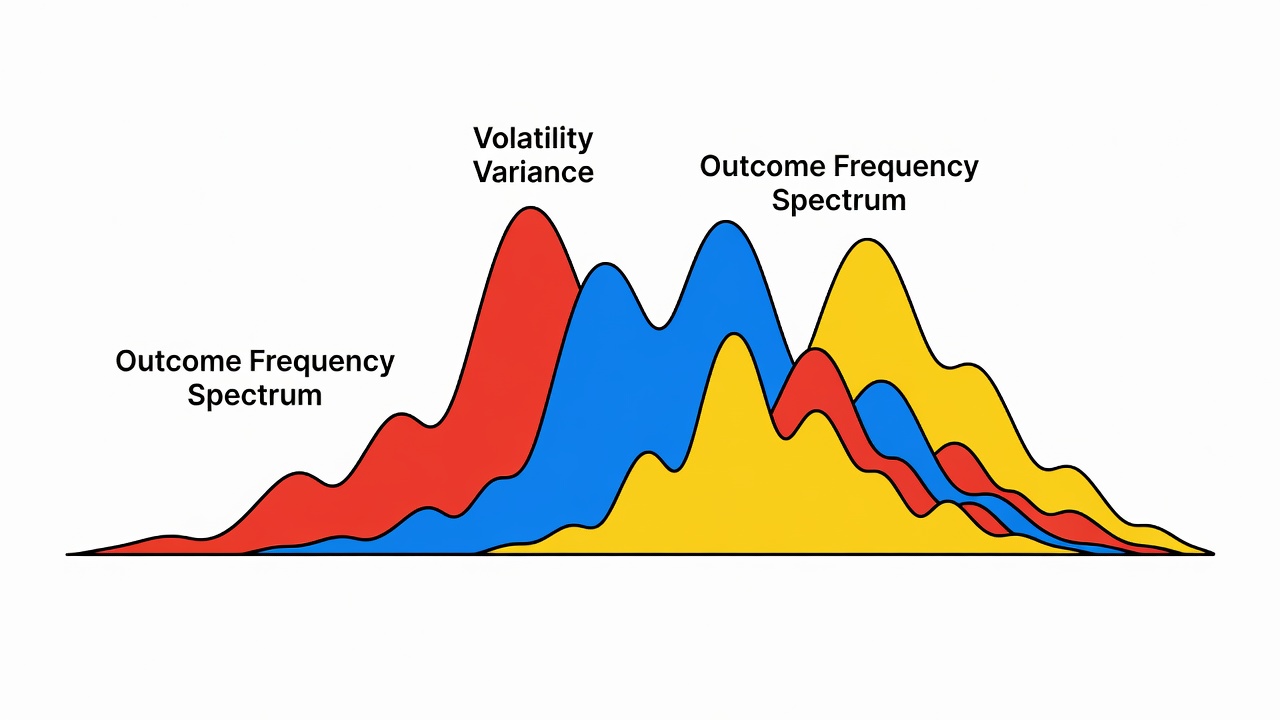
Volatility measures the distribution of payouts relative to the average. A high-volatility machine returns money in large jumps separated by long stretches of losses. A low-volatility machine returns money in frequent small increments. The difference changes how quickly your bankroll declines.
Low-volatility machines are designed for extended play. You receive frequent wins. These wins are small, often 1.5x to 2x your bet. But they arrive regularly. If you bet $1, you might win $1.50 within 20 spins. If you bet $1 on a high-volatility machine, you might play 200 spins without a win, then hit a 50x payout.
The mathematical expectation is identical. A low-volatility machine at 95 percent RTP and a high-volatility machine at 95 percent RTP have the same expected loss per dollar wagered. But the experience is entirely different.
Psychology and Bankroll
Low-volatility machines create a sense of progress. Your bankroll stays relatively stable while you play. You win, you lose, the movements are small, you continue. This creates a psychological effect: the game is neither winning nor losing. You are simply in the game.
High-volatility machines create periods of hope. Long losing streaks are punctuated by large wins. After a 50x hit, your bankroll is substantially above where it started. This creates the feeling that the machine is generous. Then the bankroll returns to baseline through subsequent play.
The player's playstyle determines what suits them. If your goal is 3 hours of entertainment for $50, low-volatility is optimal. Your bankroll will last longer. If your goal is a chance at a large win within a specific budget, high-volatility might deliver that experience more directly.
The House Perspective
Casinos offer both types because different players are attracted to different experiences. A machine that keeps a player at the table longer (low-volatility) generates more time-on-machine. A machine that offers the chance of a large win (high-volatility) appeals to different psychology.
The casino profit margin is identical. Both types are set to the same RTP by the regulator. The difference is purely in how the expected loss is distributed across your play session. You will lose the same percentage of money regardless. You just experience the loss differently.
Practical Selection Criteria
To choose between high and low volatility, ask yourself: "Do I want to play for 5 hours with a flat bankroll, or do I want to play for 1 hour with the chance of a large swing?"
Low-volatility machines (Thunderstorm, lucky ladders, steady payouts at 1.5-2x) appeal to recreational players. You sit down, you play, the money moves slowly. You can have a movie-length experience (2 hours) without going broke.
High-volatility machines (Big Spins, Mega Multipliers, progressives) appeal to players seeking the big score. You might lose $200 and quit. You might win $500 and quit. The time at the machine is shorter but more intense.
Professional players have no preference. They are indifferent to volatility because they understand expected value. For everyone else, volatility preference is a lifestyle choice, not a strategic choice. Understanding whether volatility suits you requires honest assessment of your goals. Are you playing for entertainment, for profit, or for the experience? The answer determines everything. Low-volatility machines deliver consistent entertainment. High-volatility machines deliver hope and drama. Both are valid choices if you know which you are buying. The implications extend beyond personal preference. Casinos prefer high-volatility machines because they keep players on the property longer when they are winning (hope effect) and lose faster when losing (desperation effect). Casinos place low-volatility machines in quiet areas where they expect lower traffic. This physical placement reflects the casino's understanding of how volatility affects behavior.