Overview
First: what is the Ridotto? A palazzo in Venice. Second: why did Venice create it? Revenue and control. Third: how did it work? By combining accessibility, distraction, and extraction into a profitable machine.
The Venetian Republic was declining in 1638. Sea trade routes had shifted. The Levant trade was collapsing. Turkish expansion threatened. Venice needed revenue. The city discovered it could license gambling and extract a percentage of losses. A gambling house became a tax on human wanting.
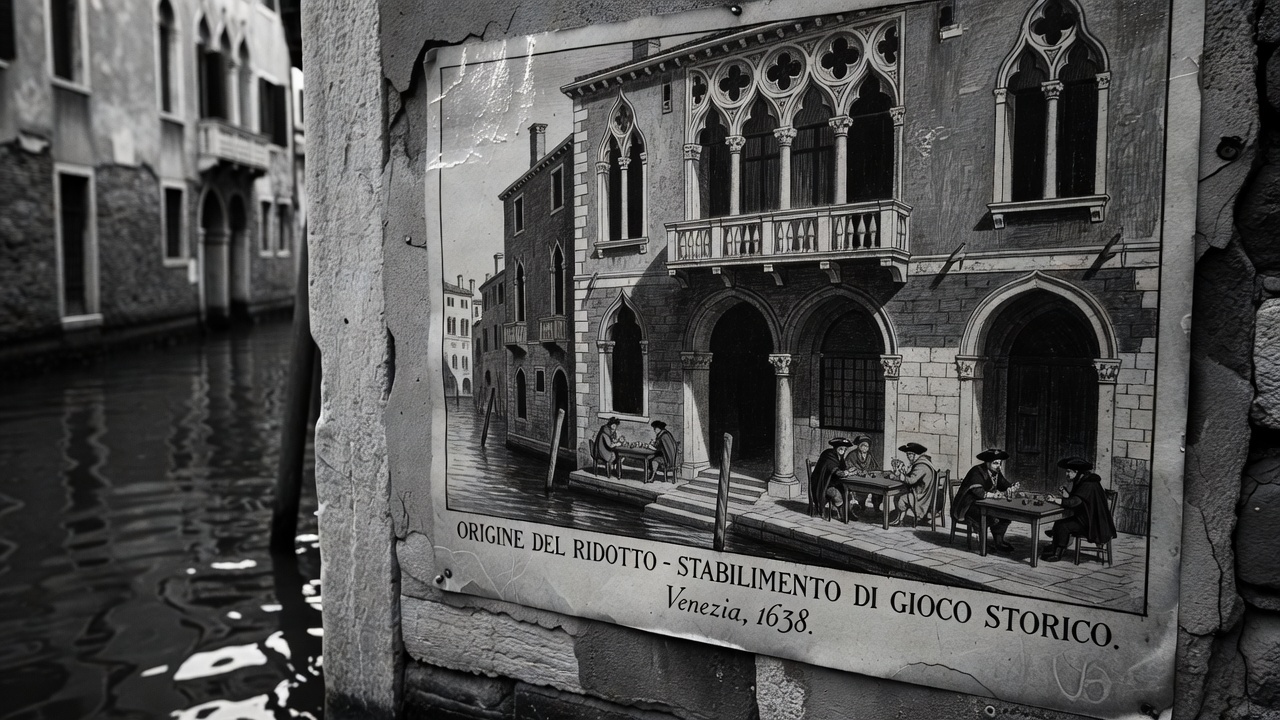
The Ridotto was located at the Palazzo Dandolo. Entry required a mask (a carnival mask). This served multiple purposes. A mask allowed nobility to gamble without shame. A mask allowed working people to pretend they were nobility. A mask created anonymity that encouraged longer sessions. No one could identify the player leaving at 4am with empty pockets.
The Ridotto charged entry. One ducat (roughly equivalent to a day's wages for a working person). This meant the gambling house was not the product. Entering the building was. Once inside, a player wagered on table games: a early form of faro, a lottery-style game, dice. The Venetian Republic took fifteen percent of the house take. This percentage ensured the government had interest in the venue's profitability.
Internally, the Ridotto was designed for retention. The rooms were connected. A player had to walk through multiple gaming rooms to exit. Each room presented new betting opportunities. The architecture was maze-like, intentional. A player leaving from room three would pass through rooms with different games in room two and room one. The sight of action created temptation.
Waitstaff circulated with wine and food. The combination of gambling, alcohol, and distraction accelerates decision-making and reduces cognitive control. A sober player makes fewer bets. A player two glasses in makes more. This was 1638. The mechanics of gambling were not well understood. But the practice of intoxication-as-acceleration was already discovered.
The rules were written. A house could not refuse to pay a winning bet. A player could not demand odds that broke the game. All disputes were settled by a referee appointed by the state. This was remarkable: gambling under law. Not gambling in secret. Not gambling at the risk of prosecution. Gambling with state guarantee of contract enforcement.
What the Ridotto proved was that gambling could be taxable and profitable for government. For two hundred years, the Ridotto operated. It generated steady revenue. The Venetian Republic never had to worry whether the house would fold. The state was the guarantor.
The mathematics were invisible to players. Each game had a house edge. A faro player was probably wagering on games with 5 to 10 percent house advantage. But the house edge was not announced. Players believed they had a chance. The illusion of agency was the product. The state and the house operators knew the edge was certain. They extracted it night after night.
When Napoleon closed the Ridotto in 1797, the transition was smooth. Gambling simply moved to unregulated venues. The revenue source left government and returned to private operators. This is the pattern that persists. When government licenses gambling, government profits. When government bans it, organized crime profits. The mathematics remain identical. The extraction happens regardless. Only the beneficiary changes.