Report No. 180
How to Handicap Preseason Games Without Getting Burned
The brief
Preseason sports betting presents a specific set of challenges. The value proposition appears attractive because odds makers are uncertain and lines move heavily in response to early information. This document outlines the operational realities that cause novice bettors to lose capital rapidly in preseason windows.
Q: What makes preseason betting different from regular season betting?
A: In preseason, teams are explicitly managing player availability and game focus. Starters are rotated out. Development players receive extended minutes. Coaching decisions prioritize roster evaluation over winning the specific game. This breaks the assumption that teams are optimizing for victory, an assumption that anchors regular season analysis.
Q: How much does roster status change between preseason and regular season?
A: Substantially. In NFL preseason, teams deploy approximately 70 percent backups and development players. A quarterback playing preseason week three might not appear in regulation until week six. A running back who started preseason week two might not see the field until week twelve. The performance data you gathered does not transfer to regular season contexts.
Q: Should I bet on preseason at all?
A: This is a legitimate question. The edge for sharp bettors in preseason is approximately half the edge in regular season. A regular season bet with a three percent edge becomes a one percent edge preseason. For casual bettors, the edge is negative, meaning the bettor is disadvantaged regardless of analysis quality.
That said, if you elect to engage preseason betting, structure it as a small-stakes learning opportunity rather than profit generation.
Q: How do odds makers approach preseason lines?
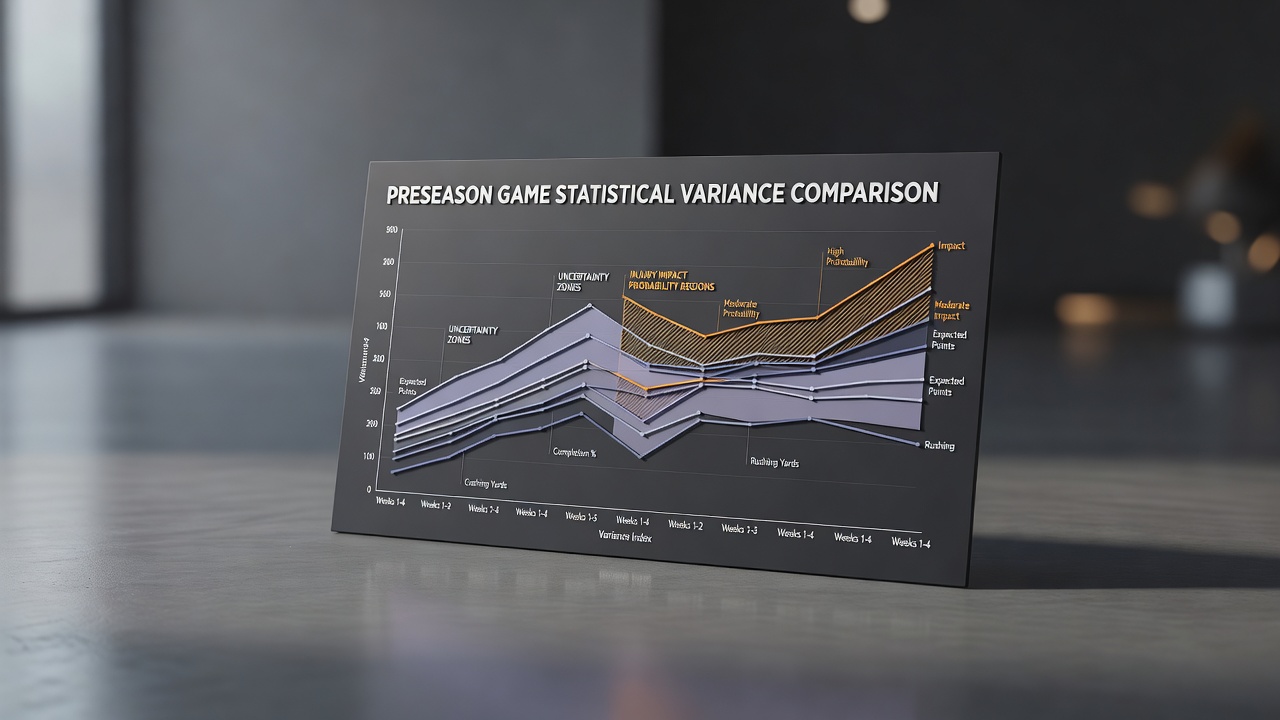
A: Lines are set wide to accommodate uncertainty. A preseason line might be two or three points wider than a regular season line. This width reflects genuine ambiguity. Because uncertainty is high, sharp bettors have slightly increased opportunity to identify mispriced lines. However, this opportunity is not available to bettors without advanced modeling.
Odds makers are aware that preseason betting volume is lower and volatility is higher. Lines are positioned to balance early action without taking excessive liability on either side. Movement happens quickly in response to information about player availability.
Q: Which information matters most in preseason?
A: In rank order: absence of key starters, coaching statements about personnel plans, injury status (distinguishing between rest and real injury), team record in previous seasons, draft class strength. Box scores matter least because they reflect development coaching rather than competitive intention.
Q: How should I weight practice reports?
A: Cautiously. Practice reports come from team media, which are incentivized to generate attention. A report that "backup quarterback X looked sharp" might reflect 30 seconds of good play out of a two-hour practice. The signal-to-noise ratio is poor. Use practice reports to identify consensus expectations, not as direct predictive signals.
Q: Can I beat preseason lines with advanced analytics?
A: Only if your analytics account for the non-competitive nature of preseason play. Standard models that work in regular season will overweight recent game performance and underweight development objectives. You would need a separate model built on preseason data, which requires significant historical database work. Most bettors do not have this resource.
Q: What about betting props in preseason?
A: Prop lines in preseason are where casual bettors generate the worst outcomes. Lines on "over under 100 passing yards for backup quarterback Y" reflect uncertainty so extreme that even minor modeling gives false confidence. The actual completion percentage of backup players varies wildly based on game flow and coaching preferences. Props amplify the volatility problem.
How to Approach It Operationally
If you decide to bet preseason, establish these parameters: first, allocate a fixed percentage of your bankroll, no more than five percent of total gambling capital. Second, restrict bets to game outcomes only, avoiding props and parlays. Third, track your record rigorously to understand if you are actually gaining edge or experiencing random variance in your favor.
Many bettors begin preseason with the conviction that they see value everyone else is missing. Three weeks later, they are down capital and convinced the lines are rigged. More often, the bettor was operating without sufficient edge to overcome variance. Tracking forces you to separate the two.
Q: Should I look at historical preseason records to understand matchups?
A: Yes, but carefully. If Team A beat Team B 21-14 in preseason last year but lost 31-24 in regular season, what does the preseason result indicate? Very little. Team compositions change. Coaching emphasis changes. Roster depth changes. Preseason records rarely predict regular season matchups. Use preseason history for identifying coaching style and development priorities, not for direct prediction.
Q: At what point does preseason value disappear?
A: Week four of preseason in NFL, the final tune-up game. By this point, starters are playing extended minutes. Coaching decisions are closer to competitive. Lines tighten as uncertainty decreases. This is the lowest-value period for preseason betting because the edge is smallest.
Q: What is the most common preseason betting mistake?
A: Overweighting recent game results without accounting for player development context. A starting running back playing 40 snaps in preseason week two looks like a feature of game strategy. It is actually part of a rotation plan. Bettors see the playing time and conclude the team is committed to that player as a starter. The assumption proves incorrect when the regular season begins and depth chart decisions were already made.