Overview
A machine operator in Reno, 1952, spent thirty years studying the Bally 777 machine. He could predict the next three symbols with 80 percent accuracy by watching the timing of the rotor before the player pulled the handle. The casino fired him. Thirty years later, when electronic slots emerged, prediction became mathematically impossible.
Blackjack faced the same evolution. In the 1970s, card counting was public knowledge. The MIT card counting team was already famous. But counting required tracking all cards. A sharper named Danny Haas asked: what if you only tracked aces? Aces were the rarest valuable cards. If aces clumped, you could predict whether a shuffle was favorable.
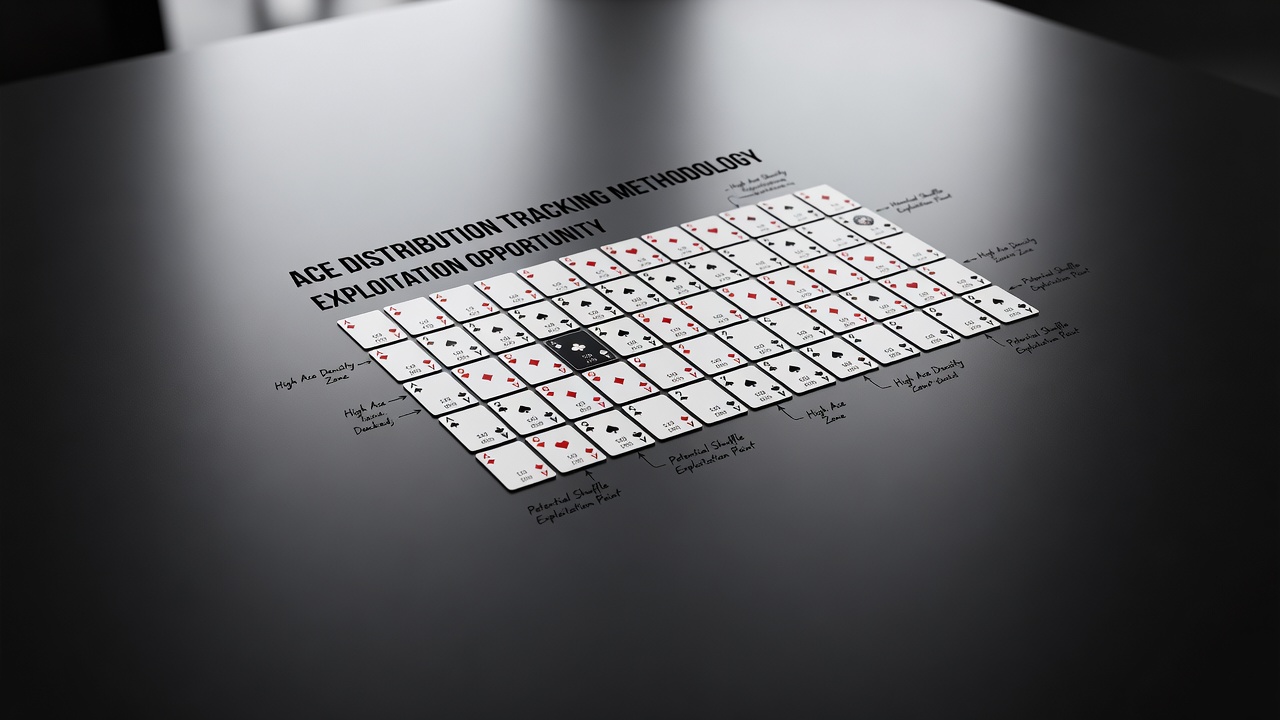
Ace tracking works like this: you notice when the deck becomes ace-rich. All four aces are above the cut card, which means they will appear in the next two shoes. You only play during ace-rich penetration. You bet more when aces are abundant because ace-rich decks favor the player (ace-ace blackjack is 3:2 payout; dealer busts more often with ace-lean shoes).
The theory is sound. An ace-rich deck mathematically favors the player. A player tracking just aces can achieve an edge of 0.5 to 1.5 percent over the house depending on penetration and bet spread. This requires zero counting skill, only observation.
Practice reveals complications. First, ace clumping is easier to track in a live room than in software. An online casino's shuffle is deterministic. Aces do not clump; the algorithm distributes them evenly. Casino software that simulates blackjack can implement provably fair shuffles. A human casino dealer might shuffle poorly and create clumping accidentally, but this requires sustained observation.
Second, the casino notices. A player who only plays during certain penetration depths and only during certain shuffle cycles is playing too smartly. Surveillance watches for bet pattern changes that correlate with deck composition. A player who bets 50 dollars when the deck is ace-lean and 300 dollars when the deck is ace-rich is announcing themselves.
Third, modern casinos use continuous shufflers. A continuous shuffler reinserts cards back into the deck after every hand. This eliminates penetration tracking entirely. You cannot know how many aces are remaining if new cards are constantly entering. The shuffler destroyed ace tracking as a viable strategy.
A blackjack mechanic would observe that old machines from Bally (1970s onward) did have tracking vulnerabilities. The rotor speed varied microscopically based on cumulative wear. An operator with a half-second delay in pulling the handle could bias the outcome. By the 1990s, electronic clutches eliminated this variance.
Modern slot machines and shufflers represent an engineering response to decades of tracking attempts. The design goal shifted: make the outcome independent of any observable pattern. Randomness itself became the security feature.
Ace tracking remains theoretically valid at single-deck games with poor shuffles and human dealers. Practically, such conditions are rare. Most casinos either use continuous shufflers, multiple-deck shoes with consistent shuffling, or have surveillance that flags bet-pattern anomalies before a player can profit.
The lesson for a mechanic is this: every exploitable machine gets fixed. The casinos that allow ace tracking are either so small that exploits do not matter, or they are testing grounds where trained spotters watch for exactly this behavior. By 2026, professional ace tracking is dead. The machine has evolved.