Horse racing's most reliable bet, the win wager, is boring: pick a horse, hope it finishes first, collect 2-to-1 or whatever the odds dictate. Sophisticated? No. Profitable, if you understand bloodlines and track conditions? Possibly.
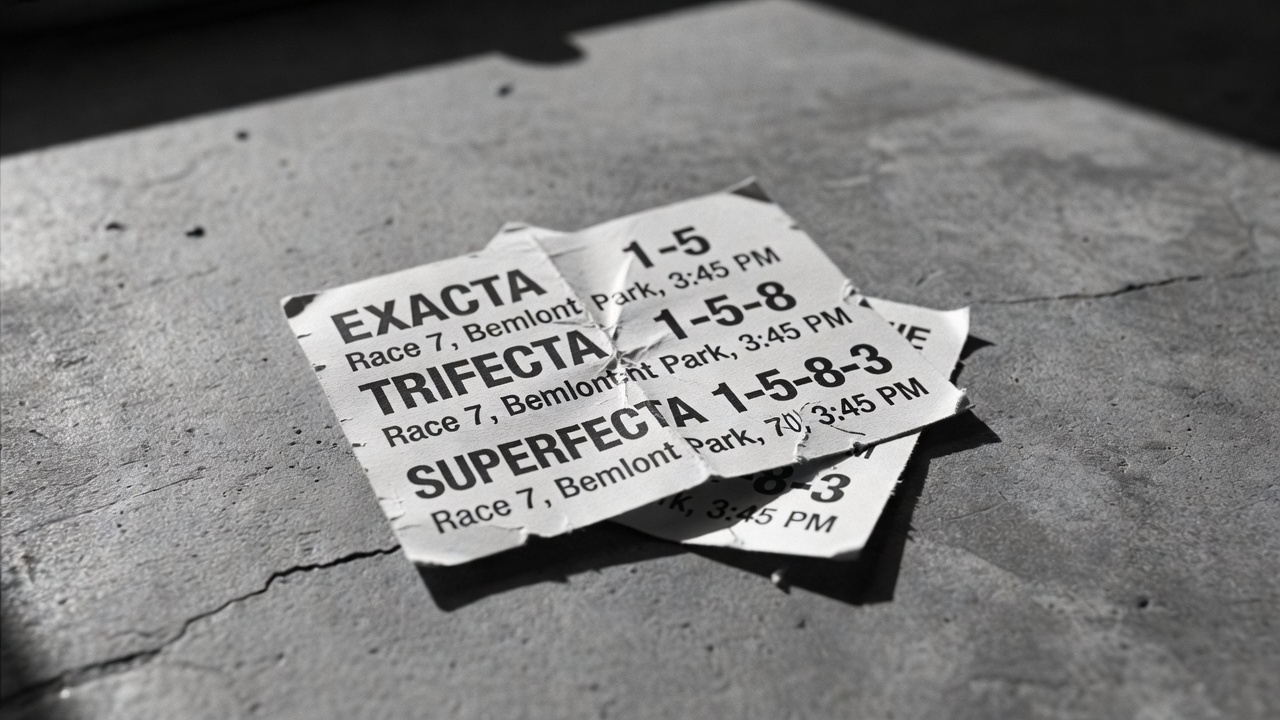
Somewhere in the 1960s, someone decided that was not enough. Enter the exacta: pick two horses to finish first and second, in order. A trifecta: three horses, three positions, exact order. A superfecta: four horses, four positions, one correct sequence out of 24 possible sequences.
The Math That Kills You
An exacta on two horses where the first is 8-to-1 and the second is 5-to-1 pays roughly $80-$100 depending on the track. Sounds reasonable. You are betting $2 on a specific outcome.
Now multiply that by the fact that the odds you see are not fixed. They fluctuate with the volume of money. A horse at 8-to-1 when you looked twenty minutes ago might be 6-to-1 by the time you place the bet. The payout shrinks accordingly.
Trifectas and superfectas are worse. A superfecta on four specific horses has 24 possible finishing orders. For you to win, your four horses must finish in your exact designated order. The probability of any four randomly selected horses finishing in that exact order is about 4 percent.
To make money, you need the payout to be greater than 25-to-1. Most superfectas do not pay that much, especially on longer odds.
The Box Bet Strategy
Players often try to solve this by boxing their bets. You box four horses in a superfecta, meaning you are betting on all 24 possible finishing orders. Now your bet costs $48 (24 possible orders times $2 per combination).
Your probability of winning is now 100 percent if all four horses finish in the top four. But the payout has been divided by 24. A bet that would pay $2,400 if all four orders were weighted equally now pays roughly $100 because you are splitting the winnings across all possibilities.
You have turned the bet from "highly unlikely but very profitable" into "likely but barely profitable".
Why The Track Loves These Bets
The exacta, trifecta, and superfecta all have higher house edges than the simple win bet. A track might take 15-20 percent from an exacta pool while taking 14 percent from a win pool. That extra percentage comes directly from players' pockets.
The track also loves these bets because they feel like expert plays. A person who constructs a trifecta feels they are making a sophisticated prediction. They feel smarter. This feeling makes them more likely to keep playing.
They are not smarter. They are just playing a worse game.
The Rare Exception
There is one situation where these bets make sense: when the public is dramatically overvaluing certain outcomes and undervaluing others.
Imagine a race where one horse is heavily favored by the public (everyone knows this horse, it won last week). The exacta odds for that horse finishing first with a less-favored horse finishing second might be lower than they should be, because the public piles money on the favorite but then splits their second-place picks across many horses.
A sophisticated bettor might identify that the second-place horse is genuinely likely but the exacta payout is still generous because the public is not considering that combination. In this case, the exacta makes sense.
This requires knowing more than the public about the horses and the betting patterns. Most players do not possess this knowledge.
The Psychological Trap
The superfecta occasionally pays large amounts: $2,000, $5,000, sometimes more. These payouts are visible at the track. People remember them. When you remember that one time someone won a $10,000 superfecta, you forget the thousands of times someone lost.
This availability bias makes the superfecta seem more winnable than it is.
The actual edge belongs to the person who understands that a $2 superfecta at 8-to-1 odds when it should be 15-to-1 is a losing proposition, not a gamble. The player who avoids this bet is already ahead.
Horse racing is sophisticated enough without exactas. The person who understands pace, breeding, track conditions, and jockey performance can beat the win pool. They need not complicate themselves with combinations.
The exacta, trifecta, and superfecta are traps wearing a tuxedo. They feel refined. They feel like they require intelligence. They are designed to extract money from people who think they are smarter than they are.