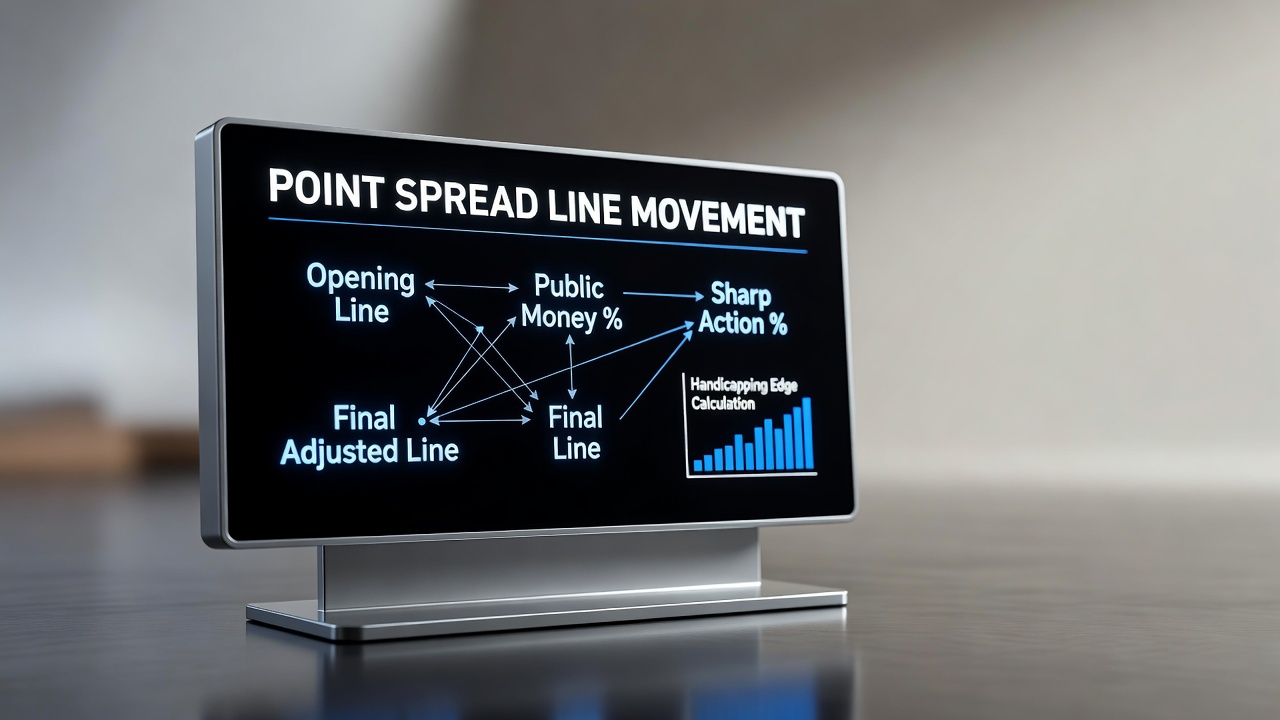
The NFL point spread is a number that represents how many points one team is favored to win by. If the Kansas City Chiefs are -7 against the Tennessee Titans, the Chiefs are favored to win by 7. If you bet $110 on the Chiefs -7, you win $100 if they win by more than 7 points.
The spread exists to balance betting action. If the Chiefs were 15-point favorites, nobody would bet on Tennessee. So the sportsbook sets the spread at -7 to attract bettors to Tennessee. This spread is not a prediction. It is an attempt to split the money 50-50 between both sides.
A beginner's strategy is to identify spreads that seem off by comparing multiple sportsbooks. If Draftkings has Chiefs -7 and FanDuel has Chiefs -6.5, there is a difference. Betting Chiefs -6.5 at FanDuel is more favorable to the Chiefs backer than betting Chiefs -7 at DraftKings. This difference is called "shopping the line."
Bankroll Management
A beginner should bet 1 to 2 percent of their bankroll on each game. If your bankroll is $1,000, a $10 or $20 bet per game is appropriate. This sizing protects you from variance. If you lose 3 games in a row, you have lost $30 to $60, which is manageable.
A common mistake is to bet too large. Betting $100 per game on a $1,000 bankroll is 10 percent exposure. A losing streak of 5 games leaves you with $500. This is not recovery. This is ruin territory.
Game Selection
Beginners should avoid betting on divisional games. These games often have unusual dynamics because the teams know each other well. Road teams perform differently depending on the destination. A team playing in Denver faces altitude effects. A team playing in Miami faces heat effects.
Weather-resistant bets are better for beginners. Indoor games are cleaner because weather is not a variable. Betting on total yardage gained is cleaner than betting on touchdowns scored, because weather affects scoring more than total yards.
Process
- Identify a game where the spread seems off.
- Confirm the spread across multiple sportsbooks.
- Identify where the line is most favorable to you.
- Place a bet sized at 1-2 percent of bankroll.
- Do not adjust your thinking based on the pregame talk or the game-day weather.
- Repeat.
The beginner who follows this process will lose money at the expected rate (the house vigorish, typically 2.5 percent per wager). The beginner who deviates (betting too large, chasing losses, betting too frequently) will lose faster. The difference is bankroll preservation.
Emotional Discipline
The hardest part of NFL betting is not picking winners. It is following your process even when results suggest otherwise. You have a system that says pass line with odds. You follow it for 10 weeks. You lose money. Every loss makes you want to deviate.
The deviation is what destroys the bankroll. You pick a "sure thing" game and bet too much. It loses. You chase by betting even more. The bankroll shrinks faster.
Professional bettors have high losing streaks. The difference is they stick to their unit sizing. They lose $500. They lose $1,000. They lose $2,000. But they do not lose their entire bankroll because they maintained discipline. Eventually, the winning streak comes, and they recover.
A beginner who cannot tolerate losing streaks should not bet on sports. The reality is that even 52 percent accurate bettors have 20-game losing streaks. This is variance, not failure.