Report No. 170
The Tim Donaghy NBA Referee Betting Scandal
On the morning of July 20, 2007, an NBA referee walked into a federal building in San Francisco to confess his crimes. What followed was the biggest integrity scandal in professional basketball history.
The brief
The first sign was small. A Las Vegas gambler named Tommy Martino, the kind of man who knows which sportsbook clerks work the graveyard shift, noticed something. In January 2007, certain NBA games were moving in patterns. Not obvious. Not every game. But enough that Martino, who had built his living on reading the pulse of money flowing through sports books, called a federal agent named Mike Haberfield.
Tim Donaghy did not look like a criminal. Six foot two. Thin hair. Wore the black shirt and white collar every game for thirteen seasons. He came from a cop family in Vineland, New Jersey. His father had been a state police official. Donaghy himself had officiated college basketball. He was, by every account, competent at what he did. And competent at what he did on the side.
The addiction came first, before the crime. Donaghy had a gambling problem. He lost money on poker. He lost money on football. By 2005, he was deep. Some accounts put his debt at three hundred fifty thousand dollars. He owed money to the wrong people. The kind of people who do not ask questions when they come to collect.
The Turn
Then, in November 2006, someone approached him. The authorities never entirely revealed who. But the conversation went like this: you are an NBA referee. You see the games before the bettors do. You could give information. Not fix games outright, just information. Which refs were feeling certain ways. Which teams were rolling. Which games mattered less. That kind of information was worth money.
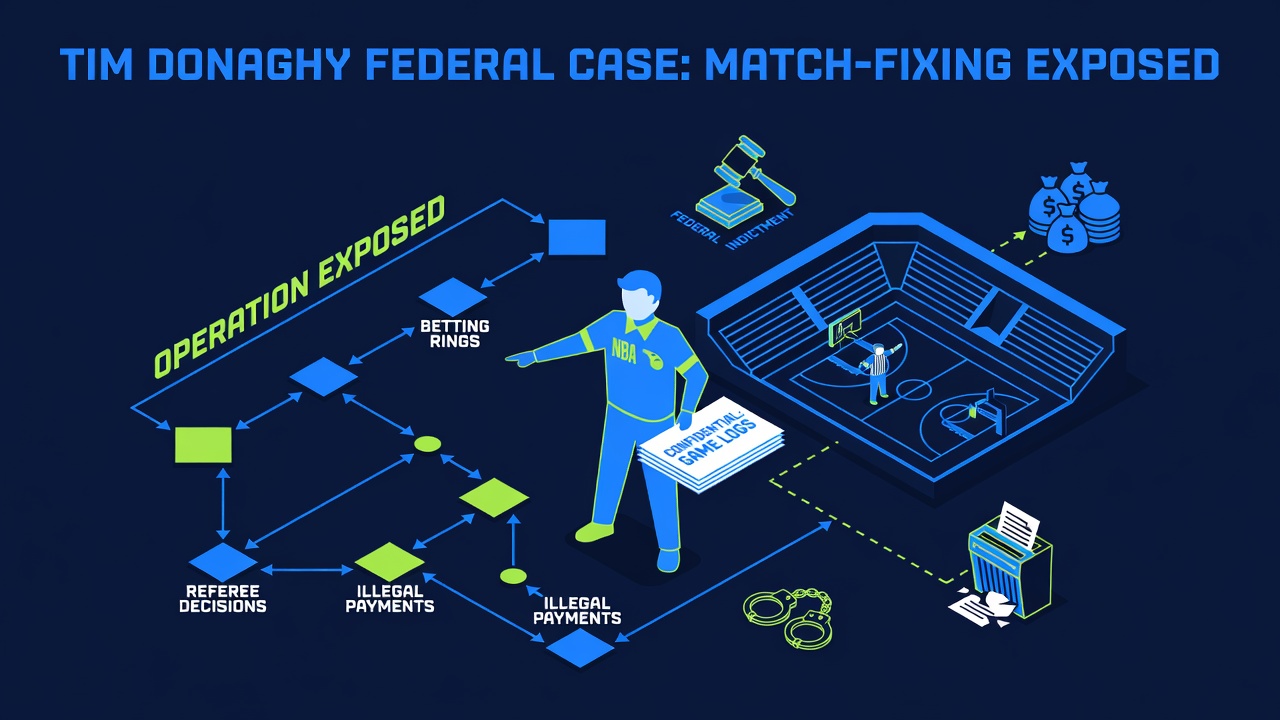
Donaghy said yes. He did not say yes immediately. But he said it. He called a gambler in Nevada and offered his insights. For cash. He gave information on about one hundred thirty games between December 2006 and April 2007. He claimed later he was not fixing games, only providing insights. The distinction matters for legal purposes. For the sport, it does not matter at all.
The phone records exist. The text messages exist. "Game plays" sent to the Nevada contact. Information about which games would be "big" and which would not. A referee is the most powerful person on the court. A referee knows which fouls he will call and which he will let go. That knowledge is worth thousands to someone who has already placed a bet.
Donaghy's scheme collapsed slowly and then all at once. In May 2007, his apartment was searched. The FBI had been building their case. They had wiretaps. They had bank records. They had the text messages. On July 20, 2007, Donaghy did what his family upbringing had taught him might someday be necessary: he walked into a federal building and confessed.
The Aftermath
The NBA was caught between institutional preservation and justice. David Stern, the commissioner at the time, made a statement. The league's credibility was wounded. Fans wondered which games had been compromised. Sports books wondered if they had been played. The season that had just concluded carried now the possibility that nothing was real.
The investigation confirmed that Donaghy had likely influenced the outcome of games through his officiating decisions, not just provided information. The foul calls came at moments that favored whatever team Donaghy had been paid to favor. He was convicted of conspiracy and wire fraud in August 2008. He served fifteen months in a federal prison in Pennsylvania.
When Donaghy was released, he could not work in basketball again. The league barred him permanently. He became a personality on ESPN, a cautionary figure, someone people brought on camera to explain exactly what he had done and why it mattered. He profited, in a way, from his confession. The usual mechanics of American redemption.
But the damage to the sport remained. The 2007 Western Conference Finals, when the Dallas Mavericks played the Golden State Warriors, was never fully clean in the minds of some fans. That Donaghy may have been involved in games that changed the trajectory of teams, of championships, of the careers of young players, sat as a fact that could not be altered. A referee who has decided the outcome of a game has done something that cannot be undone on appeal.
For years afterward, conspiracy theorists pointed to every controversial call as possible proof that the NBA was fixed. Some pointed at Donaghy. Some pointed at other possibilities. The institution had to rebuild trust that could not be rebuilt, only slowly accepted as new. Trust in the game is like trust in a person: once broken in a public way, it never returns to where it was.