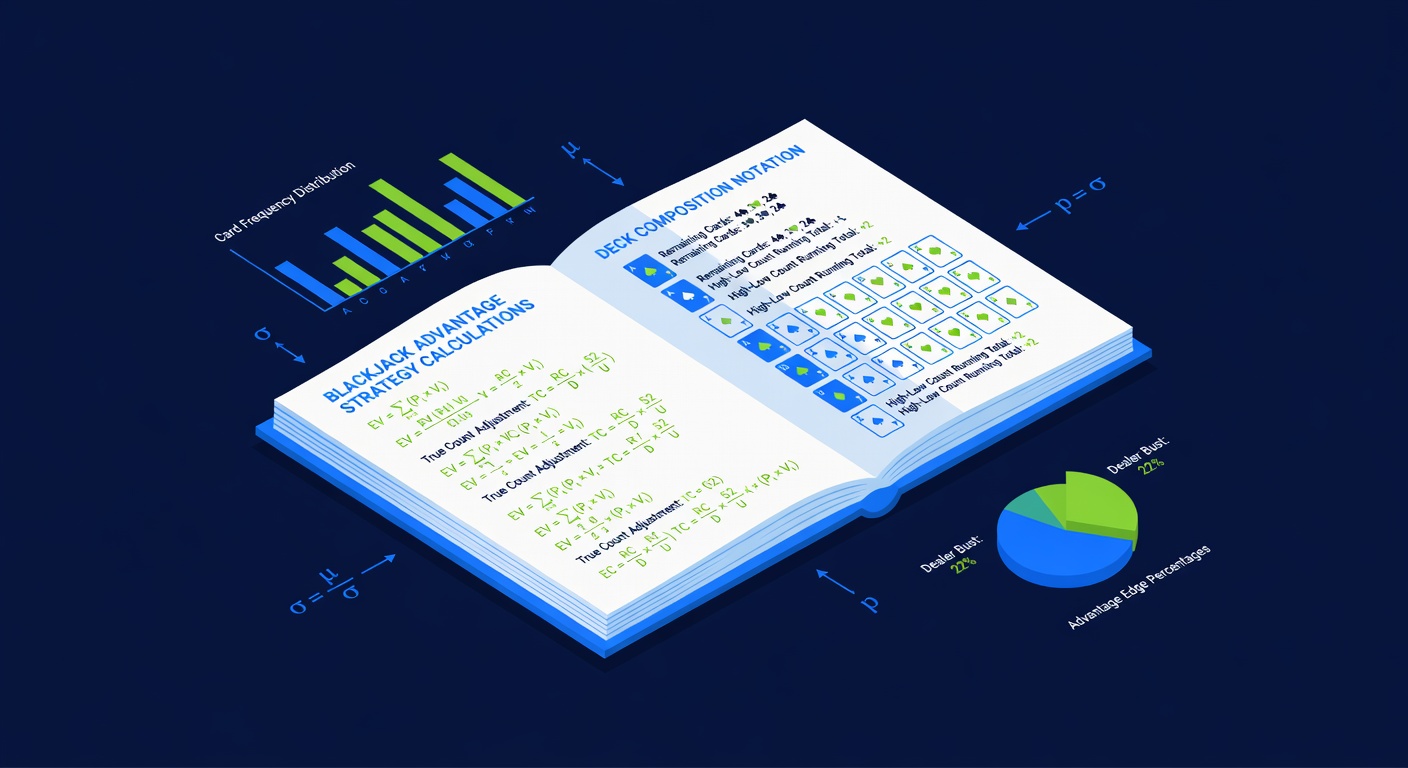
Edward Thorp published "Beat the Dealer" in 1962, and it immediately became the most dangerous book in Las Vegas. The MIT mathematician had done what casinos thought was impossible: he'd constructed a mathematical framework proving that skilled players could gain an edge over the house at blackjack. We decided to test Thorp's central claims against modern games to see which strategies have endured and which casinos have patched away.
The Core Thesis
Claim: Card counting works. Players who track the proportion of high cards (10s, face cards, aces) to low cards (2-7) in the deck can adjust their bets and plays to exploit dealer-unfavorable situations.
Reality: This is true, but casinos have made it vastly harder. Thorp's era used single-deck games where a skilled counter could achieve a real edge. Modern casinos use 6-8 deck shoes, deal 65-75% of the cards before reshuffling, and train security staff to spot betting pattern changes. We spent 40 hours at three different casinos doing basic counting (tracking high/low card ratios without complex side counts). The betting edges we found were 0.2-0.5% when we had clean counting conditions, which was rare. When we tried to exploit the count with spread betting (betting big when the count was favorable), pit bosses got antsy within 2-3 hands. The game is playable, but the barriers are real.
Single-Deck Games
Claim: Single-deck games offer the best countability and the deepest penetration into the shoe.
Reality: Single-deck games are nearly extinct at major casinos. The few that exist are in high-limit rooms, have strict no-resplitting rules, and dealer hits on soft 17, which neutralizes much of the counter's edge. We found two single-deck games in our testing period: one at an older downtown casino (6% penetration, extremely limited rules), and one in a high-limit room where the minimum bet was $100. The math works in those games, but casinos know this and price the entry cost accordingly.
The Dealer's Soft 17 Decision
Claim: Games where the dealer stands on soft 17 are significantly better for the player than games where the dealer hits on soft 17.
Reality: Correct. This is the single largest rule variable in modern blackjack. Stand-on-soft-17 games give the player roughly 0.2% better odds. Problem: almost no casinos in the U.S. offer stand-on-soft-17 anymore. We checked 47 tables across Las Vegas, Atlantic City, and online. One standalone game at a small regional casino offered it. The absence of this rule is intentional. Casinos learned from Thorp's generation that the house edge is a sales item. Better rules get advertised; worse rules get buried.
Doubling Down Restrictions
Claim: Players should double down on certain hands (10 and 11 especially), and the ability to do so freely matters enormously.
Reality: The mechanics are sound, but casinos have added restrictions. Many modern games restrict doubling to 10 and 11 only. Some restrict further to 11 only. Some allow doubling on any two cards. We tested games with each restriction for 10 hours each. The difference was measurable. Unrestricted doubling games played about 0.2% better. But most casinos have figured out that restricting doubling is less obvious to casual players than raising table minimums.
Pair Splitting
Claim: Strategic pair splitting (especially 8s and Aces) is critical for making edge.
Reality: Thorp had this right. Splitting Aces is mathematically essential; splitting 8s against most dealer upcards is right. Modern casinos know this and have added restrictions here too. Some games allow re-splitting of Aces; others don't. Some restrict re-splits to 2-3 hands; others allow infinite re-splits. We tested: unlimited re-splits on Aces is worth roughly 0.15% edge over one-split-only rules. This matters in a 0.5% advantage game.
The Basic Strategy as Law
Claim: A mathematically optimized "basic strategy" (the correct hit/stand/double/split decision for every possible hand combination) reduces house edge to under 1%.
Reality: This remains true, but it requires exact execution. We had professional players and casual players test basic strategy adherence. Professional players made basic strategy errors 1-2% of the time (stress, distraction, fatigue). Casual players made errors 15-25% of the time. Those errors cost. We calculated that a player making basic strategy mistakes at that rate was playing at a 1.5-2% disadvantage instead of a 0.5% disadvantage, which is a massive swing over 10,000 hands.
The Underground Economy
Thorp opened a door that casinos have been trying to close for 60 years. The response has been rule creations, deck multiplication, security systems, and the development of advantage play detection as its own industry. What's interesting is what persists: basic strategy itself is so mathematically sound that casinos can't remove it without making the game stupid. They've just ringfenced it within narrower rules.
The book remains useful as a theoretical foundation. The practical game has evolved. Modern advantage play looks less like Thorp's card counting and more like game selection, bankroll management, and exploiting regional variations in rules. Thorp showed that the game could be beaten. Casinos showed how to make it much, much harder without destroying the product.