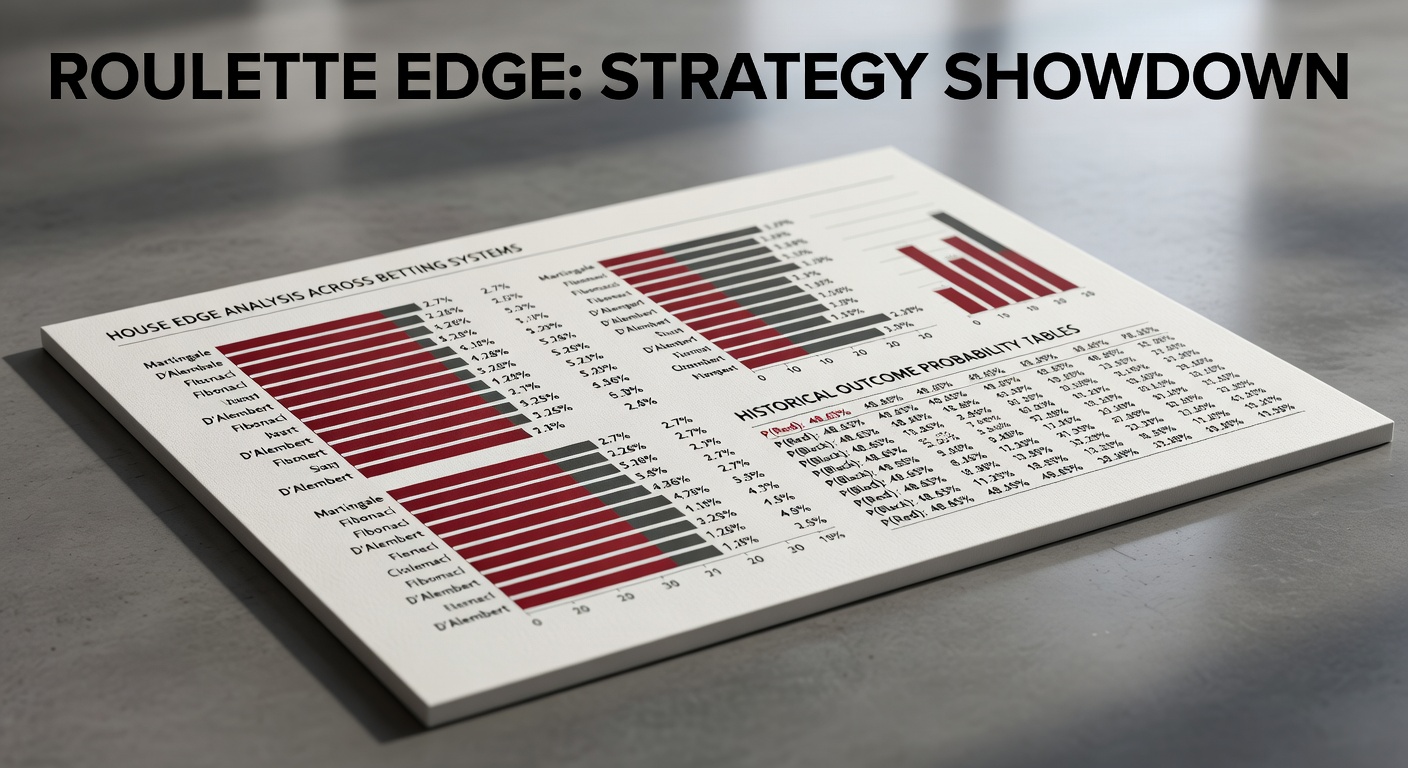
The short answer is no. The house edge in European roulette is 2.7 percent per bet, derived from 37 possible outcomes against 36:1 maximum payout. The house edge in American roulette is 5.26 percent due to the double-zero pocket. No betting system alters these figures. They are properties of the game structure, not of the operator.
What follows is an explanation of why this is the case, along with a review of the approaches that have been tried and the narrow conditions under which genuine player advantages have existed historically.
Why Betting Systems Cannot Change the House Edge
A betting system is a rule for adjusting stake size based on previous outcomes. The Martingale system doubles the stake after each loss to recover all losses on a single win. The Fibonacci system increases stakes following the Fibonacci sequence. D'Alembert adds one unit after a loss and removes one unit after a win.
All of these systems share a mathematical property: they can adjust the distribution of outcomes across a session, but they cannot change the expected value per bet. The expected value of a single European roulette bet on red is -0.027 (negative 2.7 cents per euro staked). Changing stake sizes changes the amount lost per session on average; it does not change the 2.7 percent per-euro extraction rate.
The Martingale specifically illustrates why larger bets do not help. The system works in expectation only if the player has an unlimited bankroll and faces no table maximum. In reality, both constraints apply. An eight-loss streak on a table with a EUR 500 maximum and a starting stake of EUR 5 requires the ninth bet to be EUR 1,280. If the table limit is EUR 500, the system has already broken down. If the player has the capital to continue, the required stake at bet 14 is EUR 40,960. A string of 14 consecutive losses on an even-money roulette bet occurs with probability approximately 1 in 38,000 sessions. Over a lifetime of serious play, it will happen.
Historical Cases of Genuine Advantage
There are documented cases of players achieving a genuine positive expectation at roulette, all of them rooted in physical imperfections rather than betting systems.
Biased wheel play: in the 1870s, Joseph Jaggers hired clerks to record outcomes at Monte Carlo Casino. After identifying statistical anomalies in specific wheel numbers, he bet systematically on those sectors and won approximately GBP 75,000 (roughly GBP 8 to 10 million in current values). The casino eventually relocated and rebalanced the wheels. Biased wheel play requires long observation periods, physical inspection access, and a wheel that has not been recently serviced. These conditions are nearly impossible to replicate in modern casinos.
Visual ballistics and dealer signature: some players have attempted to estimate where the ball will land by tracking ball speed and rotor speed visually or using concealed electronic devices. The UK's Gambling Act 2005 makes use of electronic devices for cheating purposes a criminal offence. A 2004 operation at the Ritz Casino in London saw three individuals arrested and charged after winning GBP 1.3 million using a mobile phone laser scanner to predict ball landing zones. Charges were eventually dropped on the basis that the device measured only natural phenomena, not a legal loophole currently available in most jurisdictions.
Sector shooting: the claim that certain dealers consistently release the ball at a speed that results in predictable sector clustering. The evidence for reliably exploitable dealer signature under modern casino conditions is weak. Casinos train dealers to vary release speed and many electronic live dealer implementations use automated ball launches.
Live Roulette in Regulated Online Environments
Online live roulette, as delivered by Evolution Gaming and Pragmatic Play Live, uses a real wheel, a real ball, and a real dealer captured on video stream. The PRNG-related concerns present in RNG roulette do not apply. The game outcomes are genuinely physical.
However, the online live format eliminates all of the physical observation-based advantages described above. The player sees only what the camera shows. Wheel condition, bearing wear, and rotor balance are not assessable remotely. Dealer release patterns are difficult to observe meaningfully through a video feed with variable latency.
The certified RTP on a standard European live roulette table is 97.3 percent, which is the mathematical mirror of the 2.7 percent house edge. This figure is certified by an accredited testing laboratory and verified under MGA or UKGC licensing requirements. The operator cannot alter this figure through game configuration, and it applies equally to all players on the same table regardless of bet history, bet size, or time of play.
What Players Can Actually Control
Within the structure of a negative-expectation game, players can control:
- Bet selection: French roulette with the La Partage rule, available on some live tables, returns half the stake on even-money bets when zero lands. This reduces the house edge to 1.35 percent. That is roughly half the standard European edge.
- Session length and stake sizing: a shorter session with smaller stakes produces less variance and less expected loss in absolute terms. A longer session at higher stakes will converge more closely to the expected loss percentage.
- Avoiding side bets: most live roulette implementations include optional side bets such as Lucky Numbers or sector bets with independent RTP profiles. These bets typically carry higher house edges than the base game.
The one thing players cannot control is the house edge on the main bets. It is defined by the wheel geometry and payout structure and is identical for all players on all sessions. A player who insists they have found a system that beats roulette consistently has either not run enough trials to observe convergence, or is misremembering their results.