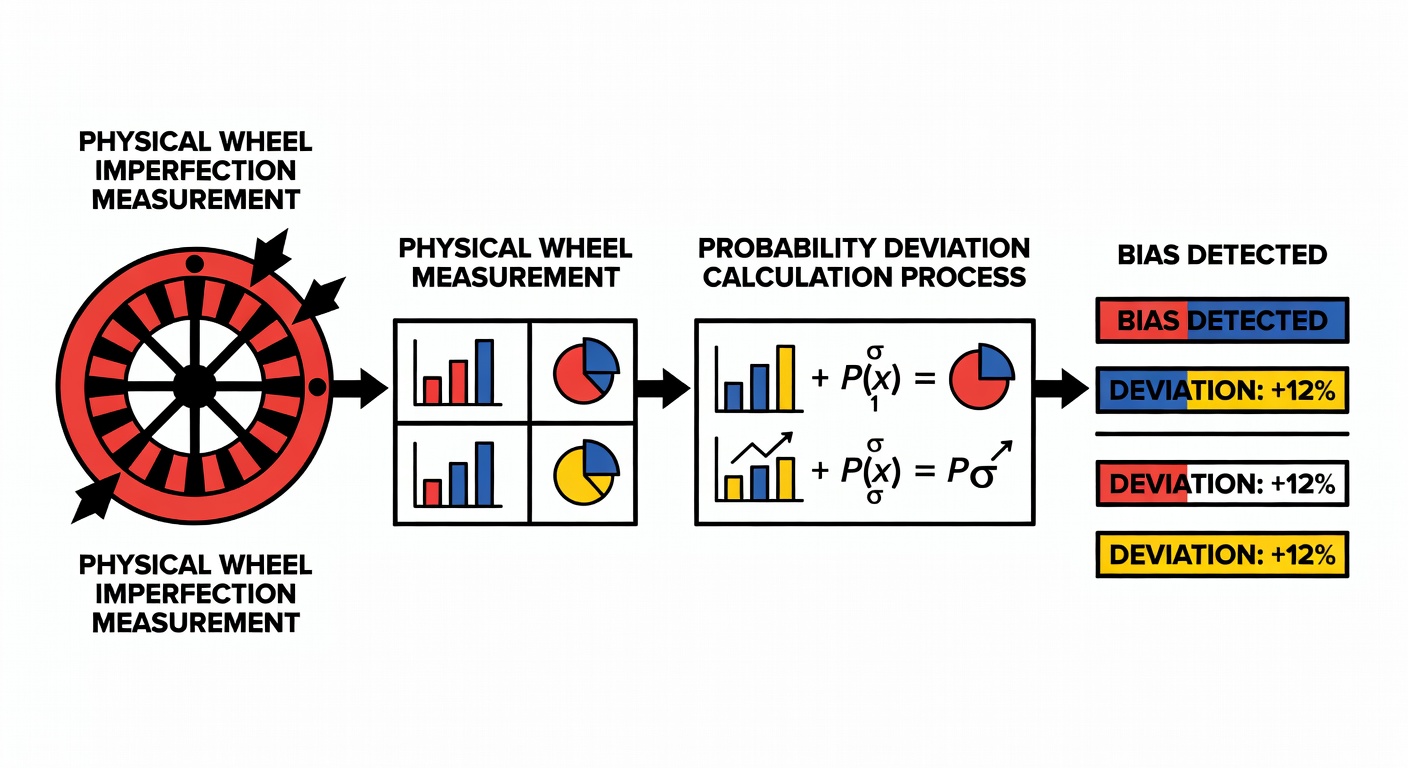
Physical Wheel Rigging Mechanisms
A roulette wheel can be rigged through several mechanisms:
1. Unbalanced Rotors
A rotor that is weighted unevenly will favor certain numbers. If the rotor's center of mass is not at its geometric center, gravity will pull it toward the heavy side over many rotations.
This is difficult to detect because the wheel still appears symmetrical. The bias emerges only over hundreds or thousands of spins.
2. Biased Pockets
A pocket that is slightly larger than the others will catch the ball more often. Pocket bias can be created by:
- Manufacture: creating pockets with slightly different dimensions
- Wear: allowing one pocket to expand through repetitive stress
- Deliberate modification: filing the pocket walls
This is more easily detected than rotor bias because the bias is visible if you examine the pockets closely.
3. Dealer Coordination
A dealer can spin the wheel and ball at consistent velocities, then watch where the ball lands and predict the region where it will settle. Over thousands of spins, a skilled dealer can increase the frequency of certain outcomes without making it obvious.
This is the hardest rigging mechanism to detect because it requires no mechanical modification. It is pure skill and coordination.
4. Hidden Magnets
A wheel containing hidden magnets under the felt, coupled with a ball containing ferrous material, can be influenced toward certain pockets. This is theoretically possible but practically difficult because:
- The magnets must be powerful enough to influence a spinning ball without being obvious
- The ball's ferrous content must be detectable by casino testing
- The magnet positions must align with the pockets, and this alignment would show under modern wheel inspection
Modern casino regulations require balls to be tested for ferrous content. Wheels are regularly x-rayed.
How to Spot Physical Rigging
1. Historical Data
Run at least 1,000 spins and track the outcomes. A fair wheel's distribution approaches a uniform distribution (each number wins 1/37 of the time on a European wheel). A biased wheel will show over 1/37 on some numbers, under 1/37 on others.
Specifically, look for:
- Any single number winning more than 3% of the time over 1,000 spins
- Any section of 5 consecutive numbers winning less than 12% of the time over 1,000 spins
The chi-squared test can quantify this statistically.
2. Physical Inspection
Examine the pockets. They should be:
- Identical in size
- Identical in height
- Equally spaced around the rotor
- Free of visible damage or enlargement
If you see variation, the wheel is either very old (worn) or deliberately modified.
3. Rotor Balance
A properly balanced rotor will spin for at least 30-45 seconds after a dealer spin before slowing significantly. A heavily weighted rotor might slow in 20 seconds. A rotor with one heavy section might favor certain numbers based on starting position.
4. Ball Behavior
Watch the ball. It should:
- Slow gradually as it spirals down
- Bounce unpredictably as it hits the pockets
- Land with apparent randomness
If the ball lands in the same region repeatedly or seems to "avoid" certain areas, that is suspicious.
Why Online Wheels Cannot Be Rigged the Same Way
An online roulette game is not a physical wheel. It is an algorithm. The algorithm generates a random number and maps it to an outcome (black 14, red 27, et cetera).
You cannot rig an online wheel by weighting it unevenly because there is no physical weight. You cannot bias a pocket because there are no pockets. You cannot coordinate with a dealer because there is no dealer.
What you CAN do with an online roulette game is:
1. Use a Biased RNG
If the random number generator is seeded predictably, you can predict outcomes. But this requires controlling the seed, and modern RNGs use hardware entropy sources that the operator cannot predict.
2. Publish Selective Results
Show players only the results that favor the house. But this would require not crediting wins properly, which would be immediately detectable by comparing the games played to the winnings reported.
3. Run a "Flashy Game" That's Rigged to Outcome
The game shows a physical wheel to create the illusion of fairness, but the outcome is predetermined by software. This is fraud, but it is detectable through:
- Comparing the wheel's visual behavior to the reported outcome
- Looking for impossible physics (the ball landing in a pocket without bouncing)
- Statistical analysis of outcomes (detecting non-random distributions)
Why Online Wheels Are Actually Safer
Online roulette at licensed operators (Evolution Gaming, Pragmatic Play, Stake) is safer than physical wheels because:
- The RNG is tested by third parties (GLI, BMM Testlabs, eCogra)
- The operator's profit comes from the house edge, not from rigging
- The regulatory framework (UKGC, MGA) requires transparency
- The games run on auditable software, not on mechanical equipment
A rigged online game is fraud. A rigged physical wheel is subtlety. The online game leaves a digital trail. The physical wheel requires only mechanical knowledge.
The Psychology of Concern
People worry more about online rigging than physical rigging because online is invisible. You cannot see the RNG. You cannot inspect the code. You have to trust the operator.
With a physical wheel, you can see and measure. This creates the illusion of safety.
But the illusion is wrong. A physical wheel is easier to rig (rotor bias, pocket wear, dealer skill). An online wheel at a licensed operator is harder to rig (external audits, regulatory oversight, digital records).
Your safety depends not on whether the mechanism is physical or digital. It depends on whether the operator has an incentive to cheat and whether there are controls to prevent it.
Licensed operators have profits at stake. Cheating would destroy their business. The controls exist. The incentive not to cheat is strong.
Unsure about an operator's license? Check the UKGC or MGA website directly. Do not trust the operator's claim.