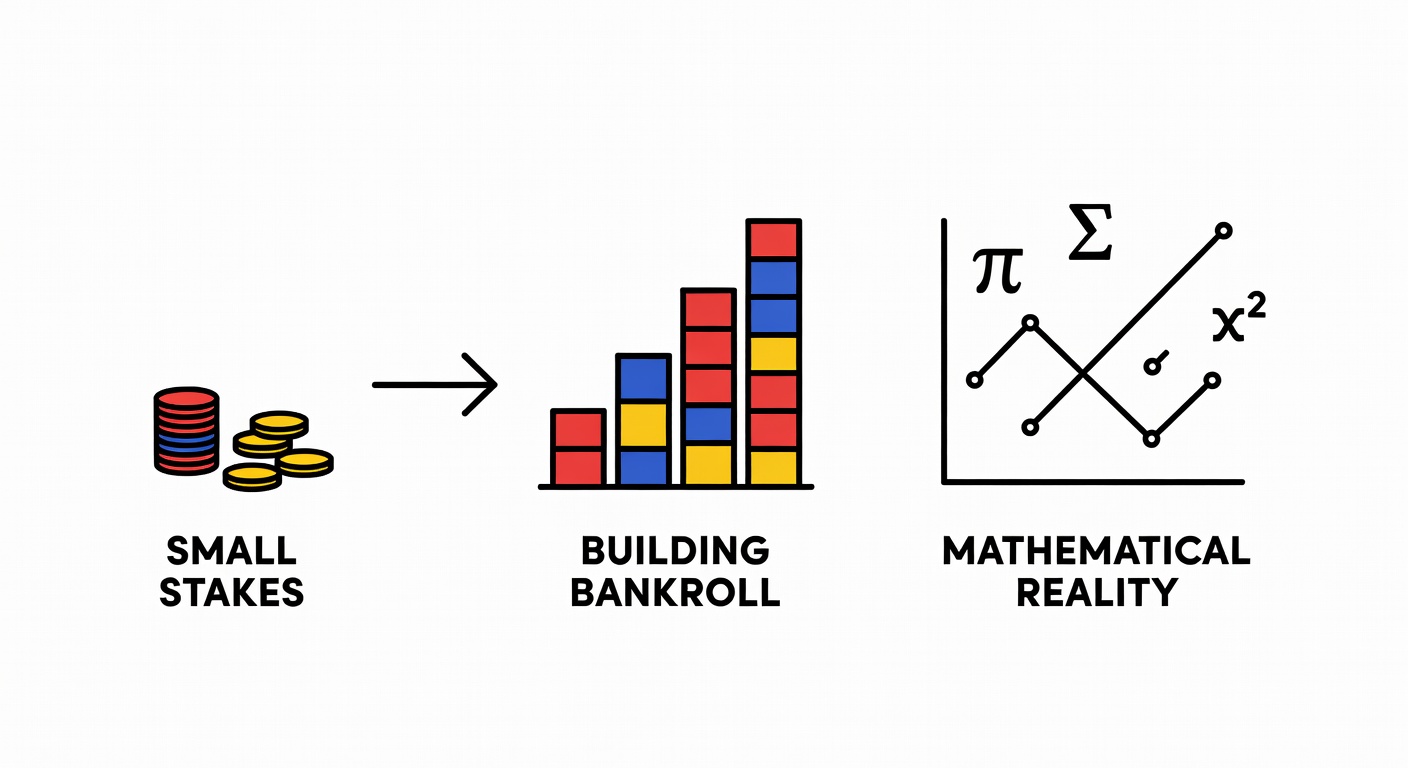
If you're starting with $500 and want to build a poker bankroll, you need to accept a hard truth: it's doable but it's tedious. You need disciplined bankroll management or you'll lose everything within fifty sessions. The standard rule is 20 to 30 buy-ins for cash games, substantially more for tournament circuits. That means if you're playing 5/10 (5 dollar small blind, 10 dollar big blind), you want a minimum roll of 1000 to 1500 before sitting down. Starting with $500? You're not ready for 5/10. You're looking at 1/2 maximum, possibly 0.50/1 if available. That's rule number one. Stay within your bankroll.
Starting small carries one advantage: rake won't destroy you. At a $1/2 table, if you're consistently winning 2 big blinds each hour, that's respectable for that stake level. 2bb/hr seems minor until you count: $4 hourly earnings, minus rake, which eats another buck. Net: $3 per hour genuine profit. Converting $500 to $1000 requires 167 hours. That's 4 weeks at 40 hours weekly, which almost nobody accomplishes. Realistically, expect 2 to 3 months of regular grinding.
The Mathematics
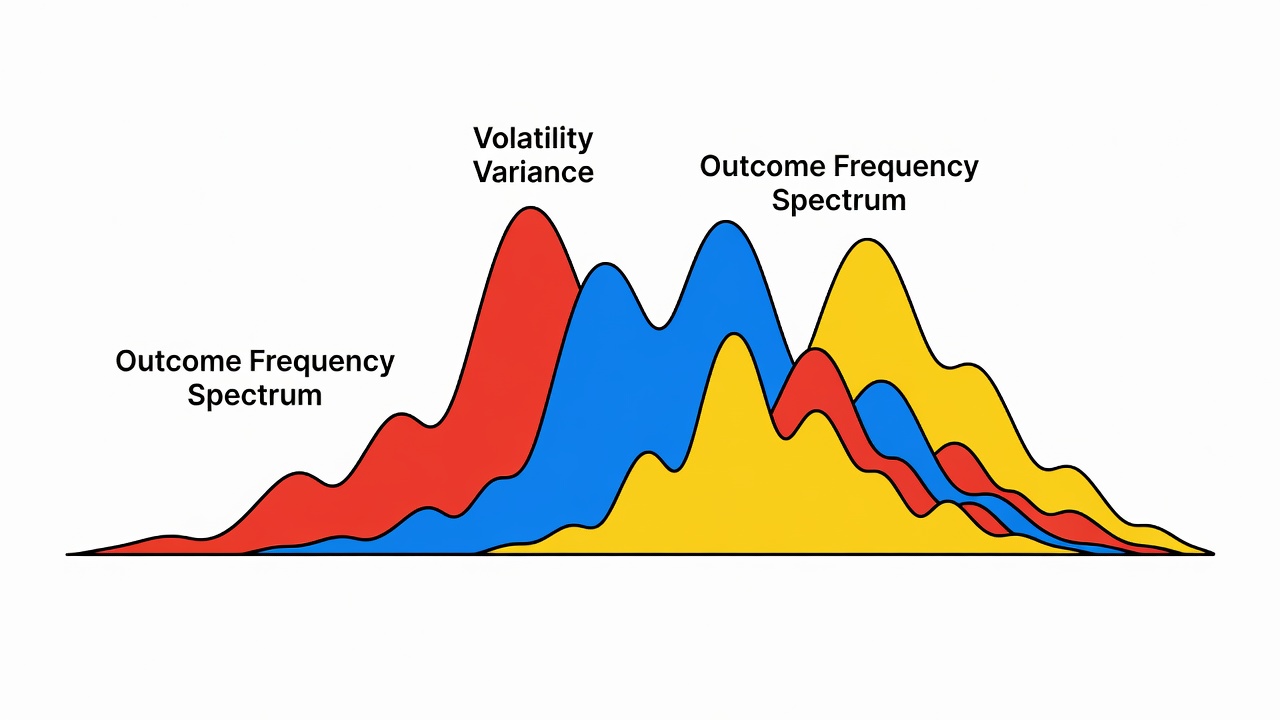
Most grinders fail because of variance. You can be playing optimally, folding 90 percent of holdings, entering pots only when ahead, and still endure a brutal week losing three consecutive buy-ins. This is normal. It's called downswing. If your bankroll is $500 and you drop three $80 buy-ins, you're down half your stack. Recovery is possible, but only through continued solid play and emotional equilibrium.
Here's the path that actually works. Start at $1/2 with $50 entries. Against soft opposition (standard at small stakes), your hourly edge should reach at least 1 to 1.5 big blinds. That equals $2 to $3 hourly earnings after rake. Commit 40 hours monthly for six months: you accumulate $500 to $750 in profits. Add this to your initial stake; you're now at $750 to $1250. Graduate to 2/4. Your bb/hr rate stays similar because the dynamic is comparable, just higher-denomination. You're generating $4 to $6 hourly. At 40 monthly hours, collect $160 to $240 per month. After another half-year, reach $1500 to $2000, then move to 3/6.
This strategy succeeds because inexperienced opponents exist everywhere. Low-limit games overflow with them. Folks who fold insufficiently. Folks ignorant of positional fundamentals. Folks treating poker like gambling instead of mathematics. You dominate these players through consistent discipline and volume, not through genius. You win by ditching marginal holdings and playing premium pairs from favorable position. Simple as that. You needn't be brilliant. Just avoid catastrophic mistakes.
The pitfall is advancing stakes prematurely. You pocket $1000 in gains and imagine you're ready for 5/10. False. The opposition plays tighter. Competitors fold less frequently and recognize positional nuance. Your hourly expectation deteriorates. Suddenly you're earning half your previous rate. Without sufficient bankroll cushioning, you'll cascade back down quickly.
Internet poker offers speed advantages technically. More hands per session. But internet also introduces bots on certain sites and sharper competition via unlimited geographic access. Higher variance due to increased hand velocity. I advocate for live games when building a modest roll because games progress slower and the talent pool is thinner. You're not battling world-class competition. You're extracting value from inferior opponents, and inferior opponents abound.
Building a bankroll safely requires not losing it. That demands selective hand choice. That requires ending sessions when results deteriorate. That requires equilibrium when variance swings. Most cannot manage this. A small profit triggers the urge to stay until reversing gains completely. You must operate differently.
Additionally: document every session. Record duration, final outcome, which game you played. Monthly data reveals your actual profitability metrics. If returns are negative, either the stakes exceed your ability or your competition is too experienced. Resolution stays identical: downgrade stakes and rebuild.
Bankroll growth slowly resembles tedium. It's unglamorous. You won't triple capital in a single week. But consistency pays dividends. Five hundred becomes one thousand in half a year. One thousand becomes two thousand in another six months. Two thousand becomes five thousand within twelve months. Following three years at disciplined stakes, you'll command sufficient capital for intermediate-level action. That's the genuine requirement. Few embrace it willingly. Most attempt sprinting before establishing fundamentals. Distinguish yourself.