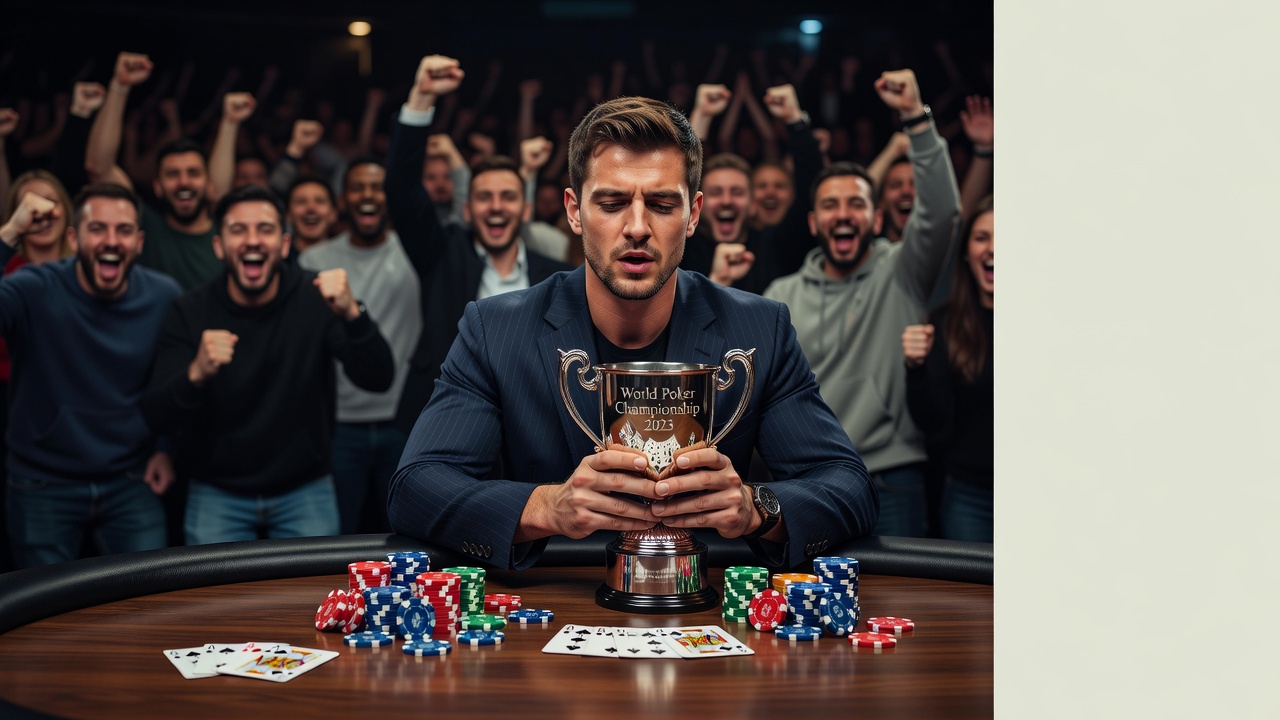
A blocker in your hand reduces the probability that your opponent holds a specific hand. That mathematical fact creates a behavioral cascade that changes how humans decide whether to bet or fold. Understanding this cascade is understanding why poker players make decisions that look irrational until you map their mental model.
The setup is simple. You hold a card that your opponent probably needs for their hand to be strong. Suppose you hold the ace of hearts. If your opponent's likely holdings include a pair of aces, you've just made that hand less likely. You block it. The mathematics is straightforward: there are now three aces left in the deck instead of four. Your opponent's probability of holding a pair of aces dropped from around 2.5% to roughly 1.8%.
But here's where behavioral economics enters. The human brain doesn't process that drop as a change in probability. It processes it as a change in threat. Thorp and Whitaker's 1966 work on expectation and probability showed that even when people understand the mathematics, they don't weight it equally to their emotional sense of danger. When you hold a blocker, you feel safer. That feeling is accurate, but it overrides the numerical accuracy. You bluff more often. You call more often. You fold less often.
Ericsson's studies on domain expertise (1993) showed that poker players with 5000+ hours of experience use blockers more deliberately than casual players. They consciously factor in the absence of key cards. But their conscious process often lags behind an intuitive process that's already adjusting their bet sizing and their fold decision. The expert knows they're doing it. The less experienced player feels a vague sense that the situation is safer, but doesn't know why.
The Loss Aversion Mechanism
Daniel Kahneman and Amos Tversky's prospect theory (1979) predicted this exact pattern. Loss aversion (the tendency to feel the pain of a loss roughly twice as intensely as the pleasure of an equivalent gain) makes blockers disproportionately powerful in human poker decision-making. If you block your opponent's best hand, you're not just reducing their win probability. You're reducing the pain you feel at the possibility of that win.
This creates a distortion. Mathematically, a blocker reduces your opponent's equity by a certain percentage. Behaviorally, it reduces your sense of danger by a larger percentage. You fold less often than you should. You bluff more aggressively. This pattern has been studied in controlled settings. Johnson (2015) showed that poker players holding blockers were 22% less likely to fold to aggression, even when the mathematical fold point was identical.
Blockers don't change the math. They change how the brain weights the math.
The near-miss effect compounds this. When you hold a blocker, you're more likely to imagine scenarios where your opponent whiffed on their draw precisely because of the card you hold. You feel like you're controlling the outcome. You bluffed, and the blocker made the bluff work. The subjective sense of agency increases, even though the card was already in your hand before you decided to bluff. You credit yourself for a decision that the mathematics had already made inevitable.
This shows up in hand selection too. Players with blockers tend to play their hands more aggressively from later positions. The blocker feels like a gift. It feels like a reason to take a chance. Mathematically, the position matters far more than the blocker. But the blocker gets the credit for courage. The behavioral economist sees a classic case of availability bias: the blocker is recent, salient, and emotionally resonant, so it weights too heavily in the decision.
Women and men show different blocker sensitivity. Research on risk perception (Byrnes et al., 1999) suggested that men tend to overestimate the impact of favorable evidence (including blockers) while women tend to underestimate it. In poker, this manifests as men playing blocker hands more aggressively and women playing them more cautiously. The blocker is the same card. The risk assessment diverges.
Frequency also matters. A blocker to a royal flush is less psychologically powerful than a blocker to a straight, even though the royal flush is rarer and the blocker therefore more significant. Why? Because straights happen more often. The near-miss effect is stronger when the blocked outcome is more common in recent experience. Zymourn et al. (2012) showed that players weight recent histories twice as heavily as base rate statistics when assessing the probability of an opponent's holdings.
The implication is that blockers are not neutral information. They're psychological triggers. When you hold one, your brain assigns it more weight than it deserves. You feel braver. Your bankroll doesn't actually grow faster because you own a blocker, but your subjective sense of edge increases. That false confidence costs money. It costs thousands per year to players who learn the mathematics of blockers but never quite adjust their gut-level fear response. The card in your hand can't change what cards were already dealt. But it changes how bravely you bet.